
What is the best AI for industrial automation in 2026?
There is no single best AI for industrial automation. Compare industrial AI by the problem it solves, from machine vision to PLC troubleshooting.
What is the best AI for industrial automation?
There is no single best AI for industrial automation.
Search for one and you will find products with remarkably little in common. An AI vision system inspecting parts for defects. Software analyzing vibration to predict bearing failure. A data platform combining historian, MES and ERP data. An assistant helping engineers write PLC code. A system tracing existing PLC logic to find out why a production sequence will not advance.
All of them are legitimately industrial AI. They are not solving the same problem.
There is a broader source of confusion, too. A general AI tool that reads purchase orders, work instructions or emails may be sold specifically to manufacturers. That makes manufacturing its market. It does not make industrial automation the thing the AI understands.
Where an AI is deployed is not the same as what the AI understands.
So the better question is: what part of the factory does the AI need to understand to solve your problem?
One stopped conveyor, five different AIs
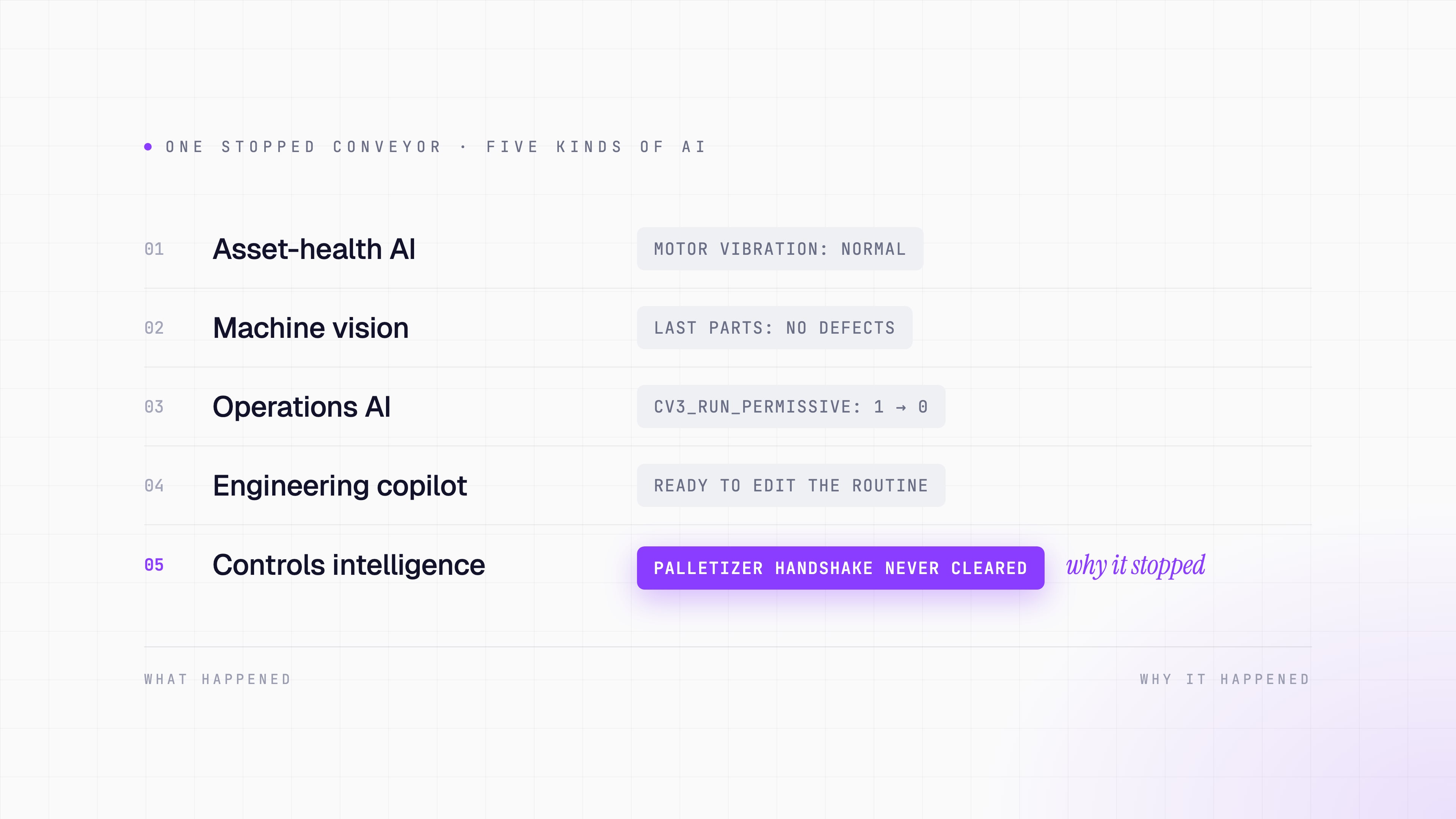
Take a single, ordinary event. At 2:00 AM, a conveyor on Line 3 stops and the line behind it backs up. Every type of industrial AI looks at that event through a different window:
- 01Asset-health AI checks the motor and gearbox. Vibration and temperature are normal. The conveyor is mechanically healthy.
- 02Machine vision checks the product. The last parts through were fine. Nothing visual explains the stop.
- 03Industrial operations AI shows the historian trend. A tag called CV3_Run_Permissive dropped from 1 to 0 at 02:00:17.
- 04An engineering copilot could help an engineer edit the conveyor routine, once someone knows what needs to change.
- 05Controls intelligence traces the logic behind that permissive. It depends on a handshake from the upstream palletizer’s PLC, and that handshake is waiting on a sensor that never confirmed the last pallet cleared.
None of these AIs is wrong. They see different parts of the same factory. The one you need depends on where the answer actually lives.
Every industrial AI has a different source of truth
| Category | Source of truth | Question it answers | Best for | Examples |
|---|---|---|---|---|
| Industrial operations AI | Historians, MES, ERP and production data | What is happening across the operation, and how can it improve? | Plant-wide visibility and optimization | Cognite, Palantir, C3 AI, IFS |
| Industrial data infrastructure | PLC and OT signals | How do we make OT data usable by other systems? | Feeding PLC/OT data to analytics and AI | Litmus |
| Asset-health AI | Vibration, temperature, ultrasound and other condition signals | Is this equipment developing a fault? | Unexpected mechanical failures | Augury, Tractian |
| Vision and quality AI | Images and video | Is this product or process visually correct? | Defects and quality escapes | Cognex, Keyence, Landing AI |
| Automation engineering AI | PLC engineering projects and standards | How do I build or change this automation? | Engineering productivity | Siemens Eigen Engineering Agent, Rockwell FactoryTalk Design Studio Copilot, Beckhoff TwinCAT CoAgent, Schneider Electric |
| Controls intelligence | Existing PLC logic, dependencies, automation context and live controller state | Why is this automated system behaving this way? | Long diagnosis time on automated equipment | PLCs.ai |
The boundaries are not absolute, and modern platforms increasingly overlap. But the distinction holds, because the quality of an AI answer depends on whether it understands the information where the answer lives.
1. Industrial operations and data AI
Industrial operations AI works across large volumes of operational and enterprise data. Cognite, Palantir, C3 AI and IFS all belong broadly here, although their scope differs considerably. These are broad, capable platforms for visibility, optimization and planning across a plant or an entire enterprise.
What they have is access to industrial data. That is not the same as understanding control logic.
In the Line 3 example, the historian shows exactly when CV3_Run_Permissive changed. Explaining why it changed means tracing interlocks, handshakes and dependencies through one or more PLC projects. The data point and the control logic are related, but they are different context.
Industrial data infrastructure companies such as Litmus make the distinction especially clear. Litmus connects to PLCs and industrial equipment and turns raw OT signals into contextualized, governed data that analytics and AI applications can use. Reading a PLC tag and understanding the logic that sets its value are two different problems.
2. Predictive maintenance and asset-health AI
Predictive-maintenance AI looks at the physical condition of the equipment. Augury uses machine-condition data, including vibration, temperature and magnetic signals, to detect developing faults. Tractian combines vibration, ultrasound and temperature data with AI diagnostics to identify failure modes.
The question they answer is: is something physically going wrong with this asset?
When the problem is a failing bearing, that is exactly the right question. But on Line 3, the conveyor was healthy. It never received a start command, because an upstream condition was not satisfied. That answer is not in the vibration signal. It is in the control logic.
That is why predictive maintenance and controls intelligence are complementary, not competing.
3. AI machine vision and quality inspection
Cognex, Keyence and Landing AI (with LandingLens) apply AI and computer vision to inspection and quality. Their source of truth is visual: does this look right?
A vision system can catch a missing cap, a bad weld, a wrong label or an incomplete assembly. It knows what is wrong with the product. It does not need to know why the control sequence allowed it to happen, and usually it does not.
4. AI for automation engineering
A new generation of AI assistants now works inside the engineering tools themselves.
- 01Siemens Eigen Engineering Agent, launched in 2026, connects directly to TIA Portal and performs multi-step engineering tasks using project context and customer standards.
- 02Rockwell Automation FactoryTalk Design Studio Copilot can summarize projects, explain AOIs, find references and generate programs, routines and AOIs.
- 03Beckhoff TwinCAT 3 CoAgent for Engineering works inside TwinCAT, supporting code suggestions, I/O configuration, HMI work and documentation.
- 04Schneider Electric’s PLC Code Generation Copilot generates, explains and tests code in EcoStruxure Automation Expert, using Schneider’s libraries and guardrails.
These tools answer: how can AI help me engineer this automation system?
How these tools compare on PLC programming specifically →PLCs.ai vs. Siemens Industrial Copilot: which one do you need? →But most plants are not designing a new machine every morning. They are keeping the machines they already have running. And when Line 3 stops at 2:00 AM, the first question is not how should I program this? It is: why is this system doing what it is doing right now?
5. Controls intelligence: AI for the automation already running production
Controls intelligence is a newer category, focused on the control systems already running the plant.
A PLC program is more than executable instructions. It holds the sequences, permissives, interlocks, timers, alarms, handshakes and operating modes that define how the equipment is supposed to behave. Historically, getting that knowledge out required someone who understood both PLC programming and that particular machine.
The knowledge is already there, buried in PLC logic. PLCs.ai extracts it into an automation context layer, a structured model of how your automation is supposed to behave. Controls intelligence is what that layer makes possible: answers about why the system is doing what it’s doing.
What an automation context layer actually looks like →On Line 3, the answer was not in one rung. It ran from the conveyor routine to an AOI, across to the palletizer’s PLC, and down to a single sensor input. That is typical. Answers often depend on logic defined elsewhere in the project, on how several controllers interact, on plant standards and past versions, and, during a live event, on the current values inside the controllers.
That is why PLCs.ai builds structured context from whole PLC projects, rather than handing code to a general-purpose LLM as text. It maps relationships and dependencies across the project and across controllers, then adds live runtime values so answers reflect what the automation is doing now.
The goal is not simply to generate PLC code. It is to make the knowledge inside existing automation accessible for understanding, documentation, troubleshooting and safe engineering work.
Automation engineering AI vs. controls intelligence
| Automation engineering AI | Controls intelligence | |
|---|---|---|
| Starts with | What do you want to build or change? | What is this automation doing, and why? |
| Natural environment | The engineering workstation | The operating plant |
| Primary users | Automation and controls engineers | Controls engineers, maintenance technicians, automation teams |
| Centered on | Engineering the automation | Understanding the automation |
How do you choose the right AI for industrial automation?
Don’t start with “where should we use AI?” Start with the production problem you want to remove.
- 01Quality escapes? The evidence lives in images. Start with machine vision.
- 02Mechanical failures driving downtime? The evidence lives in condition signals. Look at asset-health AI.
- 03Optimization across large amounts of operational data? Look at industrial operations and data AI.
- 04Engineers spending too long writing or modifying projects? Engineering copilots deserve attention.
- 05Hours lost finding out why equipment stopped or a sequence won’t advance? The answer lives in the control logic and controller state. That points to controls intelligence.
A useful buying process comes down to three questions:
- 01What problem are we trying to solve?
- 02Where does the information needed to solve it actually live?
- 03Does the AI understand that information deeply enough to give a useful answer?
This is why rankings of the “best industrial AI platforms” mislead. Most of these products are not alternatives at all. A plant can reasonably run several at once, because each covers a different source of industrial knowledge.
So what is the best AI for industrial automation in 2026?
Cognex does not need to understand ladder logic to be excellent at visual inspection. Augury does not need to generate PLC code to be valuable for machine health. Siemens Eigen does not need to be a vendor-agnostic troubleshooting system to accelerate Siemens engineering. And PLCs.ai does not need to replace a data platform, a predictive-maintenance system or a vision system to solve the controls problem.
Don’t categorize AI by the factory it’s used in. Categorize it by the problem it solves and the context it understands.
The best industrial AI is not the one with the broadest claim or the biggest model. It is the one that understands where the answer to your problem actually lives.
What is the difference between industrial AI and PLC AI?
Industrial AI is a broad term covering AI across industrial operations. PLC AI is narrower and focuses on the control logic and automation context inside PLC systems.
What is PLC AI? The five types of tools and where PLCs.ai fits →Can AI program a PLC?
Yes. Siemens, Rockwell Automation, Beckhoff and Schneider Electric all offer AI that assists with PLC programming.
The best AI for PLC programming in 2026, compared →Can AI troubleshoot a PLC?
Yes, but asking a general-purpose chatbot about a pasted rung is very different from using AI built around PLC context. Useful troubleshooting may require the whole project, tag references, interlocks and sequences, AOIs and function blocks, other controllers and live runtime values. The quality of the answer depends less on the language model than on the automation context it is given.
Is Siemens Eigen the best AI for industrial automation?
Eigen Engineering Agent is a strong example of an engineering AI agent, built for the Siemens TIA Portal ecosystem. Whether it is the right AI depends on the problem you are solving.
Does industrial AI require new sensors?
Not always. Predictive maintenance and vision may need new sensors or cameras. Other applications work from information the plant already has: historians, MES, maintenance records, engineering files and existing PLC projects. For controls intelligence in particular, most of the knowledge already sits inside the PLC project. The challenge is making it accessible.
What AI do manufacturing plants use?
Most plants use several types at once, including predictive maintenance, machine vision, process optimization, industrial data platforms, engineering copilots and, increasingly, AI for understanding and troubleshooting controls. The right mix depends on the plant’s problems, equipment and existing technology.
More from the blog
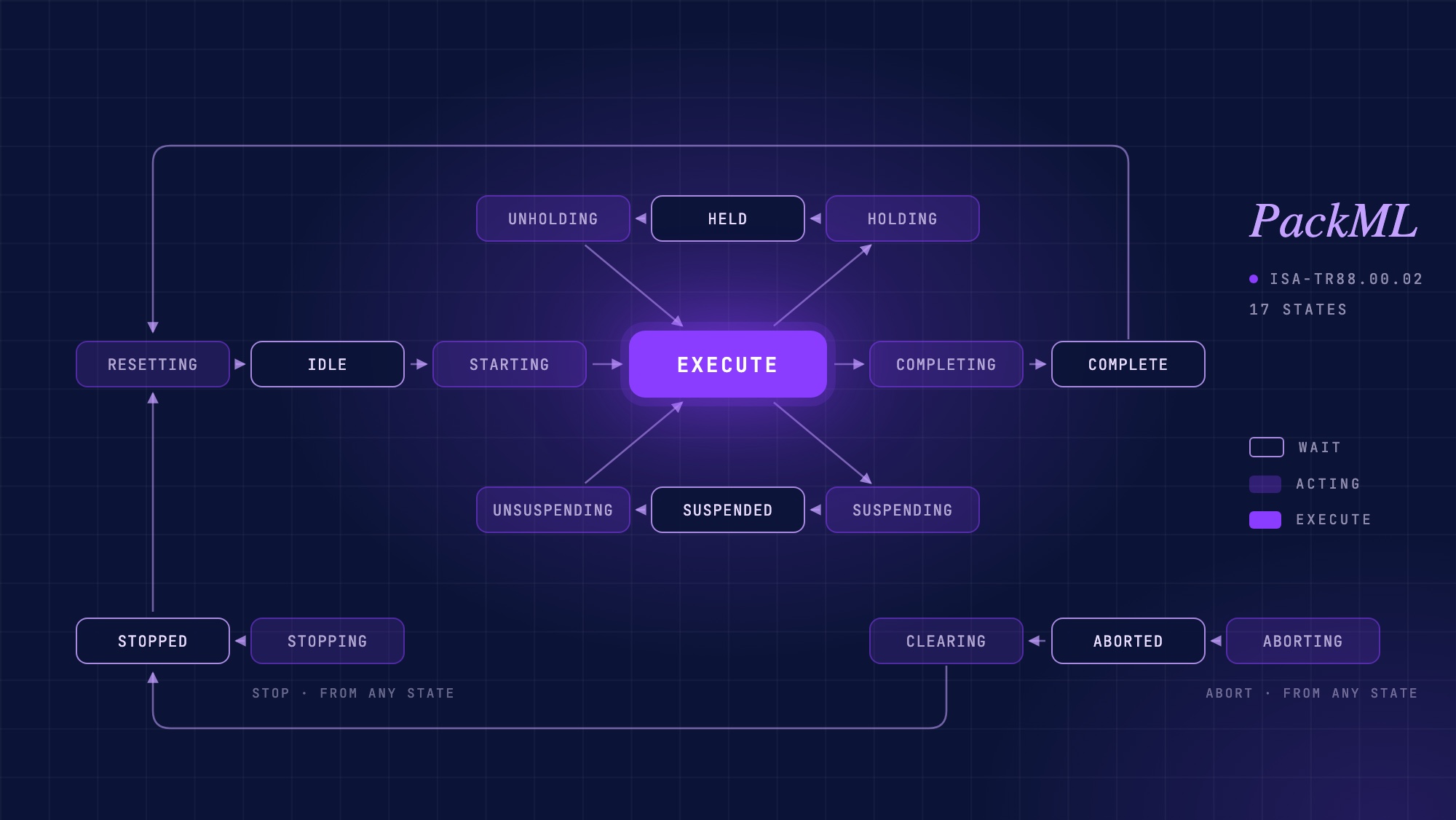
PackML explained: the state model, PackTags, and where AI fits
What PackML is, how the 17-state machine, modes and PackTags work, how to check whether a PLC project really follows it, and where AI helps.
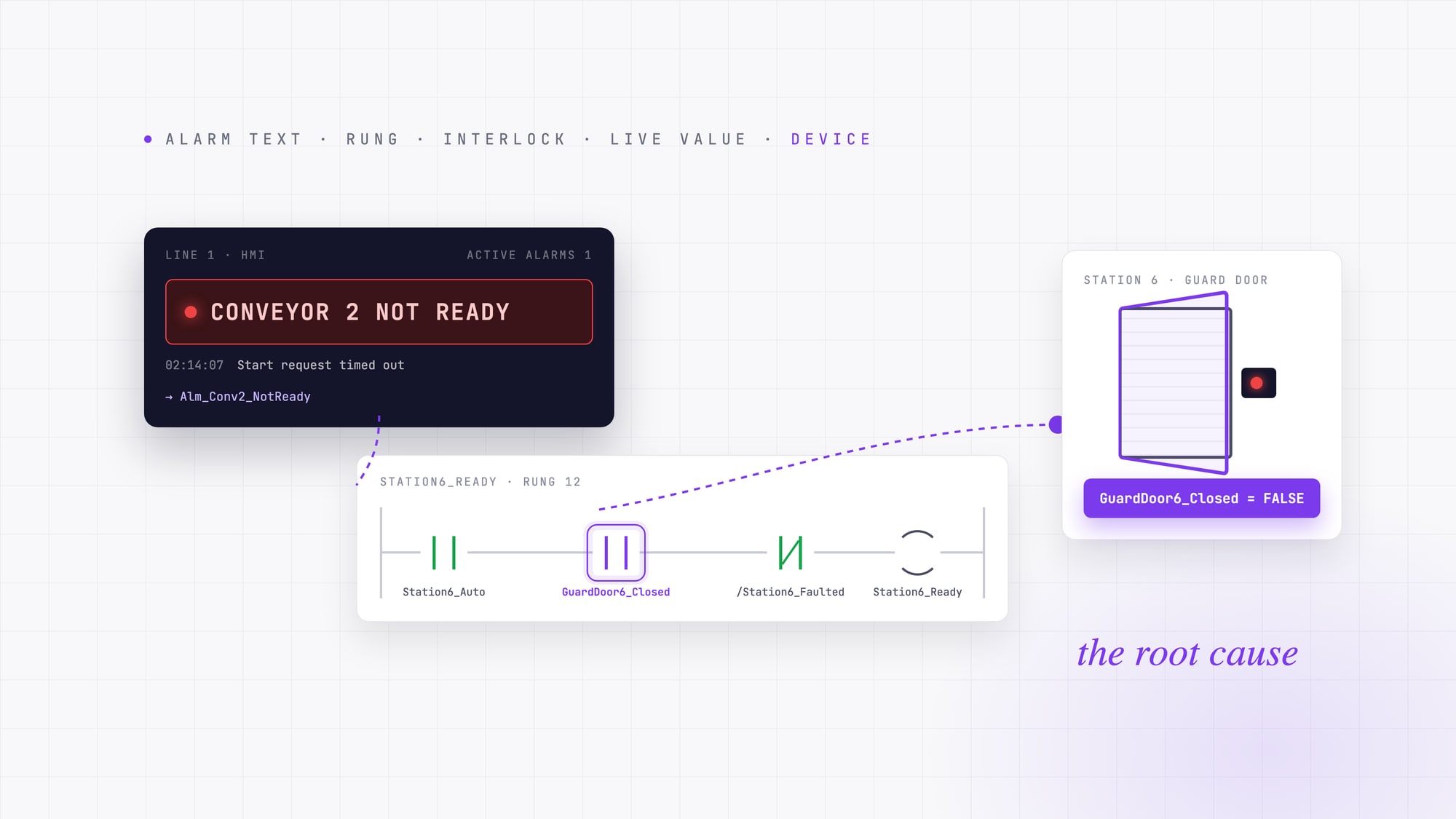
PLC fault codes and HMI alarms: how to trace an alarm back to its root cause
A PLC fault code or HMI alarm tells you where troubleshooting starts, not why the machine stopped. A field method for tracing an alarm from its text to the device behind it.
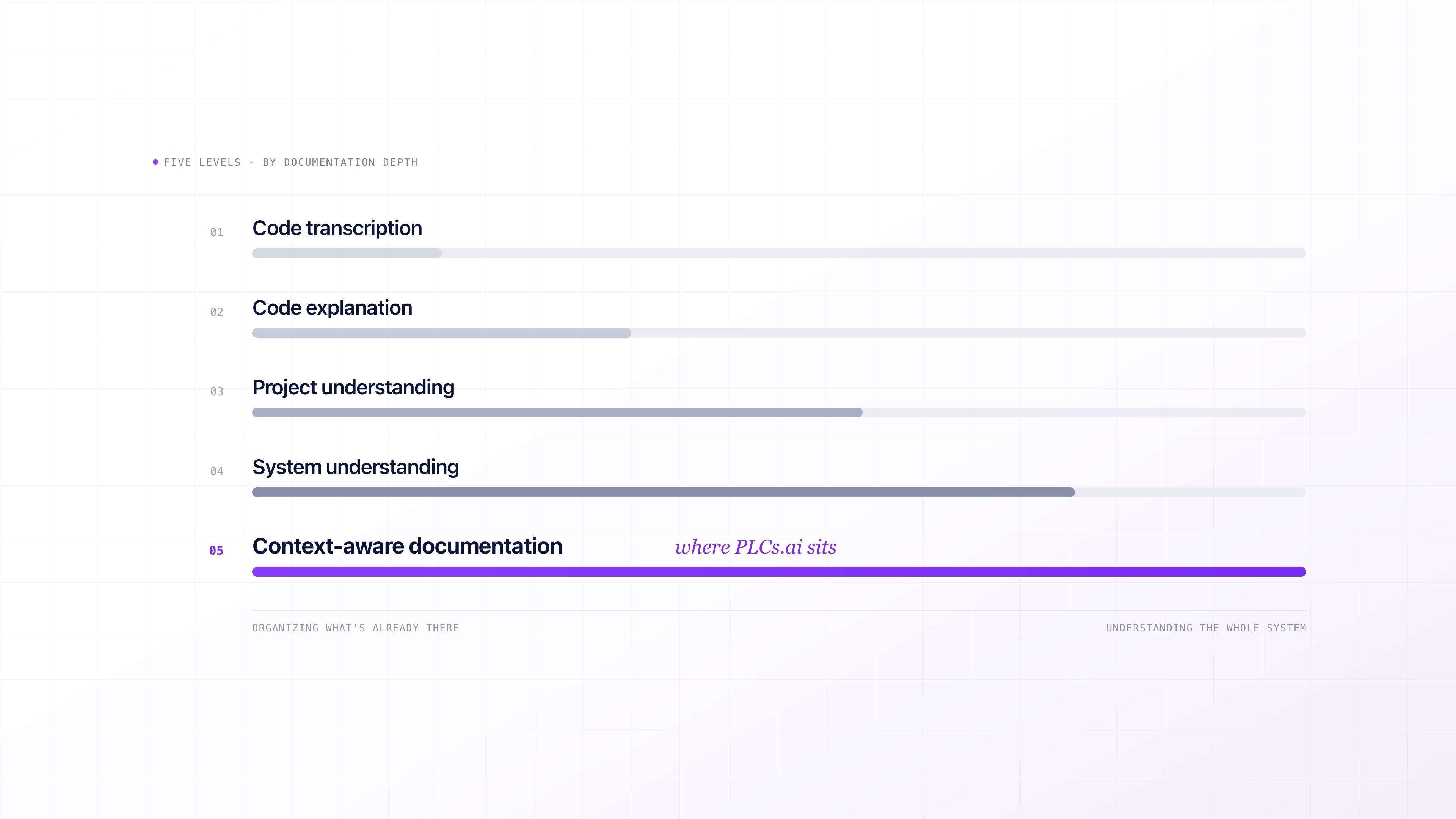
PLC documentation software: 9 tools compared (2026).
Automatic PLC documentation ranges from deterministic tools that reformat what is already in the project, to AI that infers meaning from undocumented code, to platforms that generate documentation from a broader understanding of the automation system. Nine real tools, compared on what they actually do.