
Industrial AI doesn’t have an intelligence problem. It has a context problem.
Today’s AI models are extraordinarily capable. But intelligence alone can’t tell you why a production line stopped, what an interlock protects, or what happens three stations downstream if an engineer changes a rung.
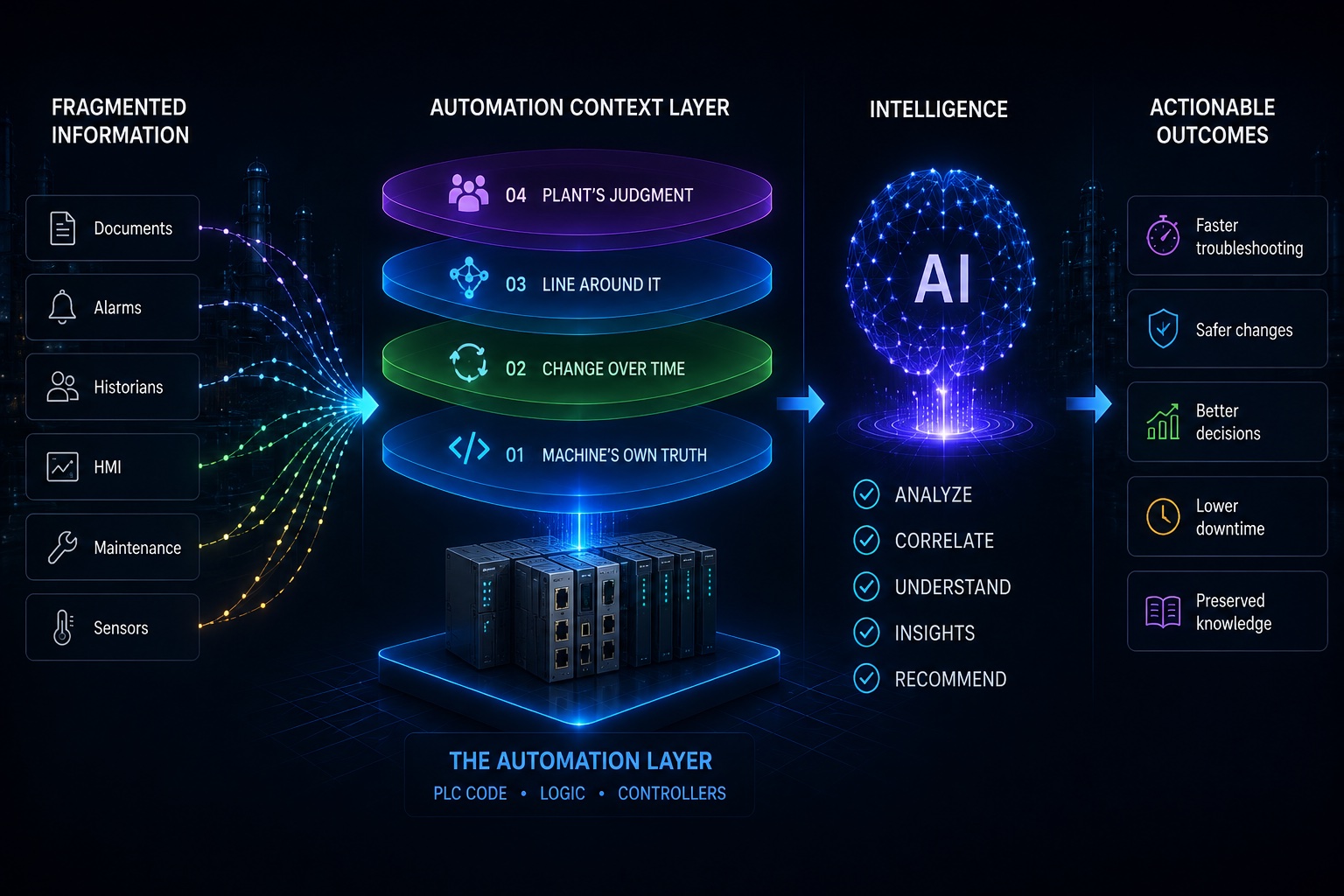
What automation context actually means
Data context tells AI what the plant is. Automation context tells it what the plant does, and why.
That context starts with the logic itself, but it doesn’t stop there.
- 01The logic. What the controller actually executes, not what the drawing says it should do.
- 02The equipment. What each piece of hardware does and what depends on it.
- 03The sequences and dependencies. What has to be true before something else can happen.
- 04The engineering history. What changed, when it changed, and how the system evolved.
- 05The relationships between machines. What one station expects from another and how behavior propagates across the line.
Together, these create something much more valuable than another source of industrial data. They create an understanding of how the production system actually works.
The intelligence isn’t in the model alone
Every AI model can explain what a PLC is.
That doesn’t mean it understands your PLC.
It doesn’t know why that timer is there. It doesn’t know what that interlock protects, which machine is waiting on that handshake, or what changed three revisions ago.
Without that context, AI is reasoning from general knowledge.
With automation context, it reasons from the reality of your production system.
Ask a generic AI why a conveyor isn’t starting and it can explain how conveyors generally work.
Ask an AI with automation context, and it can trace the start sequence, follow the permissives and interlocks, understand the upstream handshake, identify the downstream dependencies, and point the engineer back to the exact logic behind the problem.
That’s the difference between AI that knows industrial automation and AI that understands your production system.
The automation layer is the anchor
Industrial plants already have enormous amounts of data.
Historians record what happened. Asset models describe what exists. Documentation describes what was intended. Maintenance systems record what was repaired.
But the control logic determines what the machine actually does.
It contains the sequences, conditions, dependencies, interlocks, timing, alarms, and engineering decisions that govern the physical process.
That’s why we believe the automation layer is the natural anchor for industrial intelligence.
Start with the control logic. Understand the machine. Connect the machines across the line. Enrich that understanding with engineering history, documentation, standards, and operational signals.
Controller → Machine → Line → Plant
That’s how automation context becomes an intelligence layer.
Context that keeps up with the plant
Production systems don’t hold still.
Engineers modify logic. Machines get upgraded. Products change. Standards evolve. New equipment is added. Problems get solved.
A context model built once and left alone starts becoming obsolete the moment the plant changes.
Automation context needs to evolve with the production system itself.
By anchoring context to the automation layer, changes in the control system become part of a continuously evolving understanding of the plant.
Not a snapshot.
A living understanding of how the production system works.
Context is becoming the industrial AI battleground
The importance of context in industrial AI is becoming increasingly clear across the industry.
William Hearne-O’Sullivan captured this well in his recent article, “Schneider Didn’t Buy AI. It Bought Context.”, looking at Schneider Electric’s acquisition of Cognite and the broader shift from simply connecting industrial data to giving AI the context required to reason about it.
Read “Schneider Didn’t Buy AI. It Bought Context.” →We believe the same shift is happening one layer deeper, in industrial automation.
The control layer contains some of the richest context in the production environment: how machines behave, what conditions govern them, how sequences execute, how equipment depends on one another, and how those systems have evolved over time.
This is where Automation Context begins, and where we believe the next generation of industrial intelligence will be built.
Building the intelligence layer for industrial automation
Foundation models will keep getting better. The models available next year will almost certainly be more capable than the ones we use today.
But they still won’t inherently know your machines.
They won’t know your logic, your engineering standards, the relationships between your stations, or the decisions your engineers have made over years of production.
That context belongs to you.
From day one, we’ve built PLCs.ai around a simple idea: the value of AI in industrial automation comes from bringing the right intelligence together with the right production context.
We’re building that context from the automation layer outward, turning the knowledge embedded across your control systems into an intelligence layer that can be used to understand, troubleshoot, maintain, and evolve your production environment.
The models will keep changing. Your production context is what makes them understand your plant.
See how PLCs.ai builds Automation Context, layer by layer →More from the blog
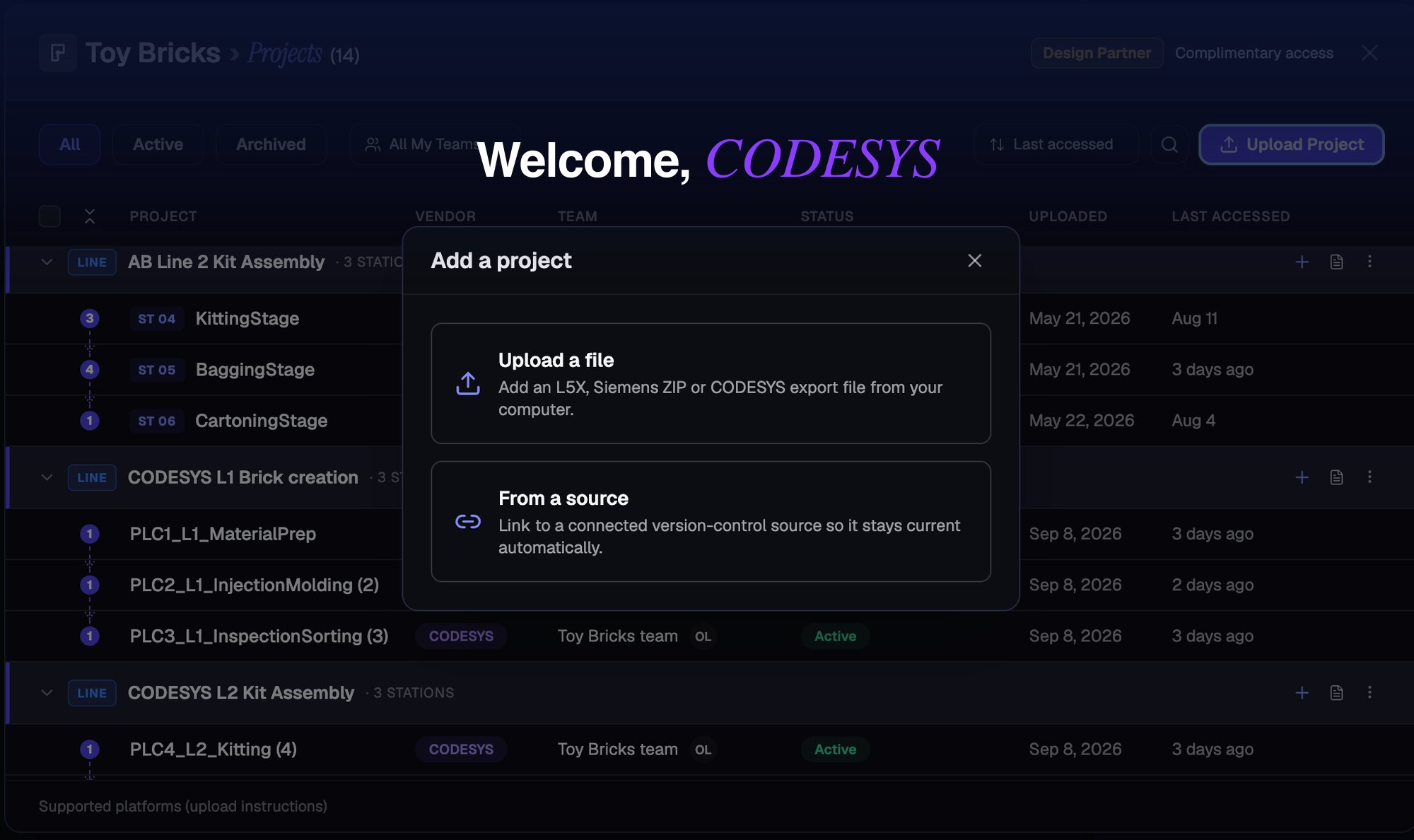
PLCs.ai now supports CODESYS V3 projects, across the entire CODESYS ecosystem.
PLCs.ai now supports CODESYS V3 projects, across first-party CODESYS environments and OEM platforms like WAGO, ABB, and Bosch Rexroth. A CODESYS export has no tag table and no hardware/IO tree, so getting there took real re-engineering, not just a new parser.
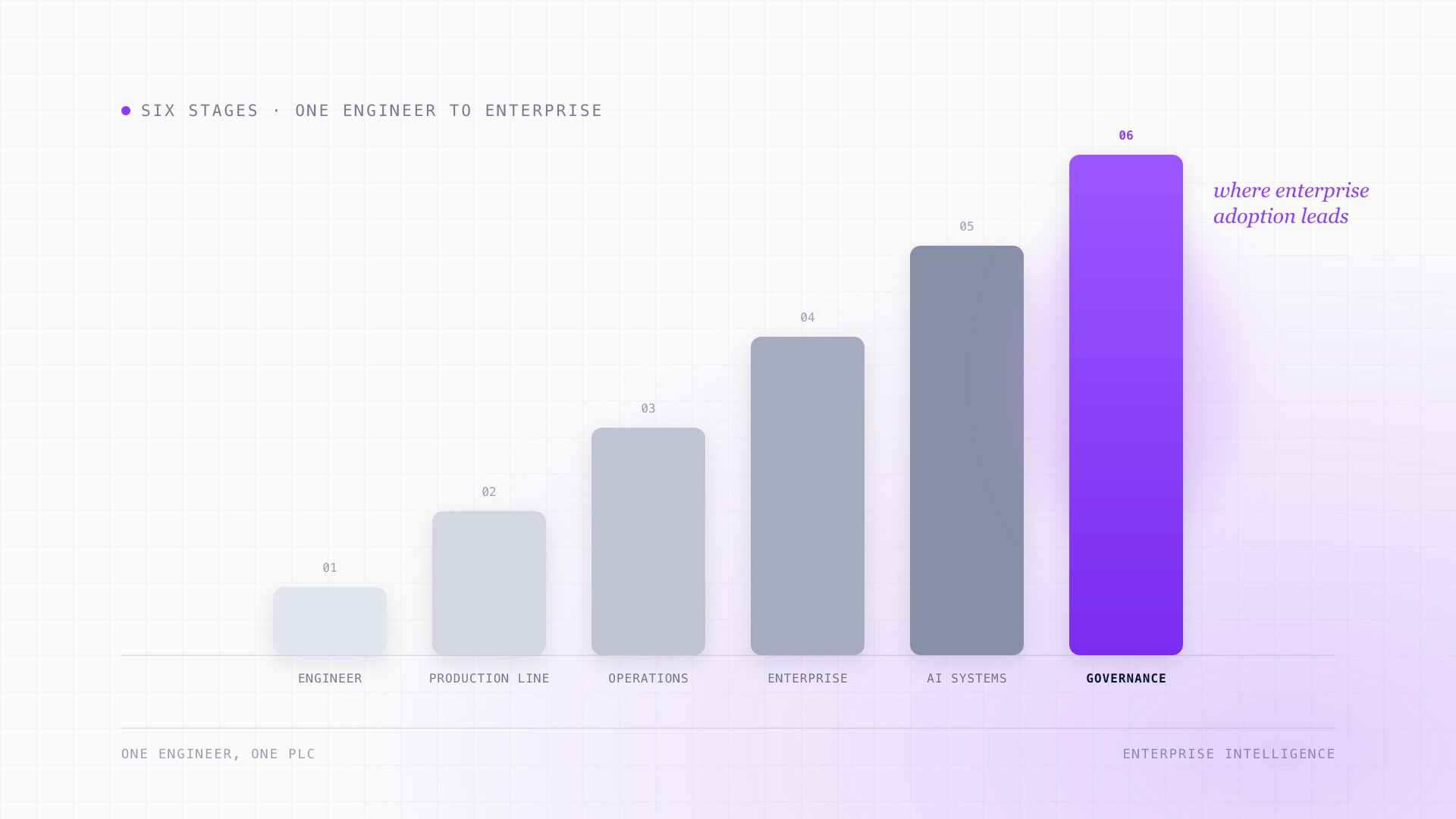
The manufacturing AI adoption journey: from individual tools to enterprise intelligence.
AI adoption in manufacturing almost never starts as a transformation. It starts with one engineer, one PLC, and one AI model. What changes at each stage after that, from helping a maintenance tech at 2 AM to governing access across an entire enterprise, and why the infrastructure needed at the end looks nothing like where most manufacturers start.
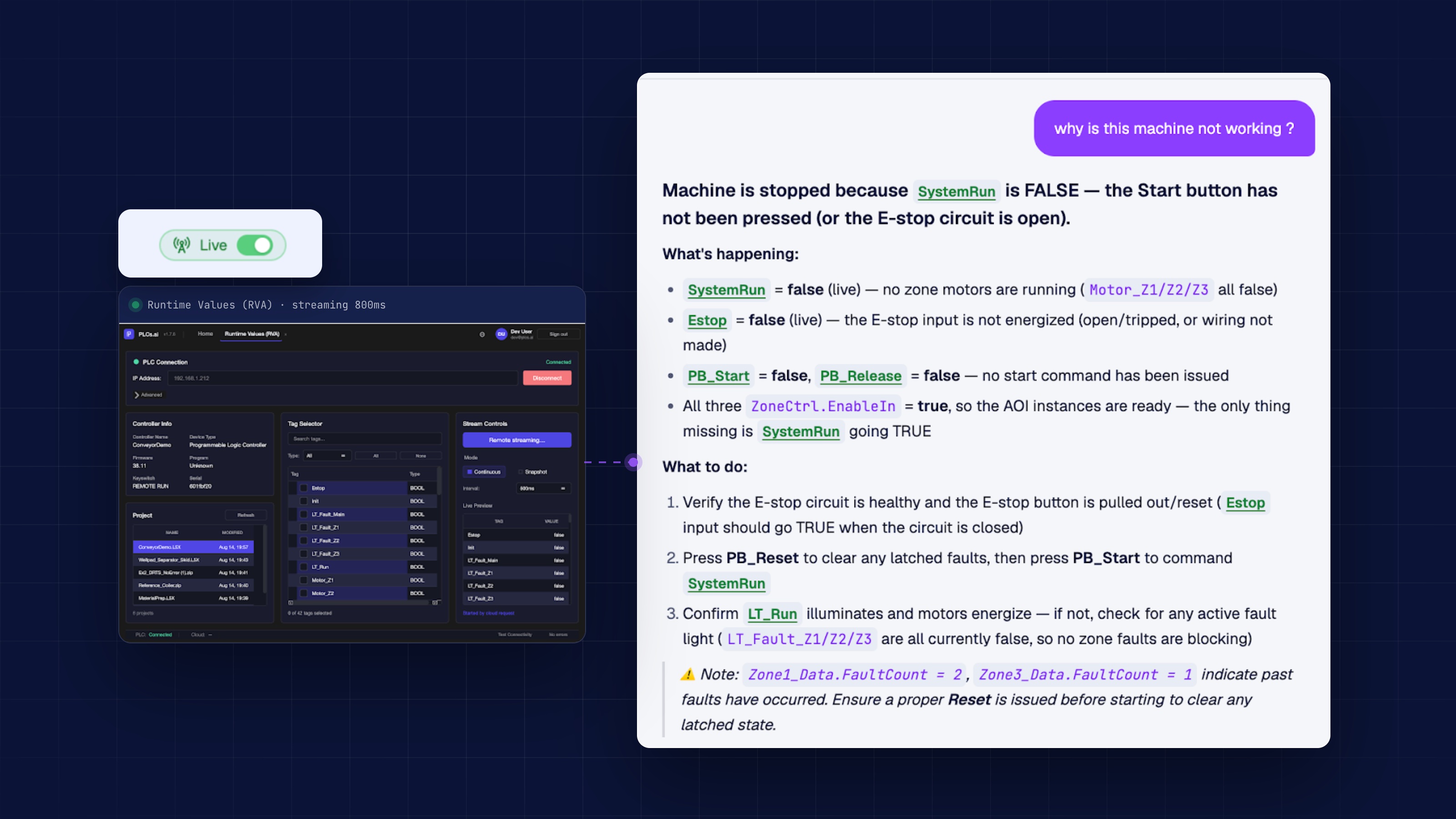
Runtime PLC data doesn’t just help troubleshooting. It multiplies it.
Reading the code tells you what a line is supposed to do. Runtime tag values tell you what it is actually doing right now. Troubleshooting needs both, and the gap between them is where most outages drag on.