
What is PLC AI? A guide to AI for PLC programming and industrial automation.
PLC AI is not one product category. It is five, and picking the wrong one costs you time before you even start. What the term means, what AI can already do with a PLC, the five types of tools on the market, and where PLCs.ai sits among them.
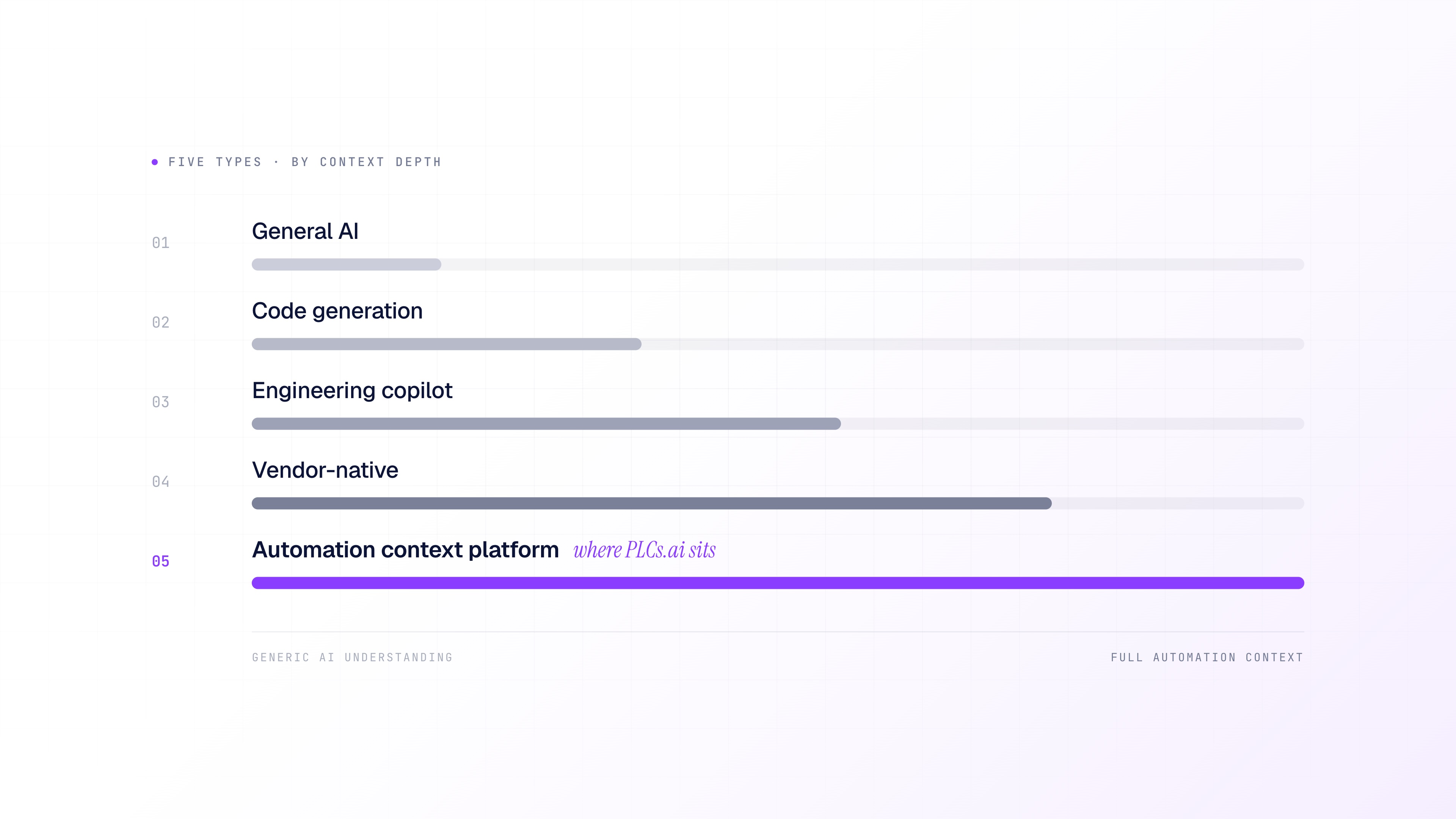
Not every tool described as "AI for PLCs" does the same thing. At one end of the spectrum, a general-purpose AI model can explain a few rungs of ladder logic pasted into a chat window. At the other, purpose-built industrial AI platforms can ingest a complete PLC project, understand its tags, routines, and engineering history, and use that context to help troubleshoot an actual production line.
Understanding that difference matters more each year, as AI moves from answering PLC programming questions to becoming part of the industrial engineering workflow itself.
What is PLC AI?
PLC AI is the application of artificial intelligence to PLC programming, engineering, maintenance, and troubleshooting.
Traditional PLC engineering tools are deterministic. Engineers use environments such as Rockwell Automation Studio 5000 or Siemens TIA Portal to create, modify, download, and monitor PLC programs. AI introduces a different interaction model: instead of manually navigating routines, tags, and cross-references, an engineer or technician can ask questions in natural language, such as:
- 01What does this routine do?
- 02What conditions must be true for this motor to start?
- 03Which interlock is preventing this sequence from continuing?
- 04What changed between these two versions?
- 05Why did this machine stop?
- 06Which other PLCs on the line interact with this controller?
The quality of the answer depends heavily on how much context the AI has. A general AI model may understand PLC programming concepts. A PLC-aware AI tool understands PLC code and engineering structures. A context-aware industrial AI platform can go further: understanding the PLC project, the machine it controls, other controllers on the line, engineering history, and potentially live operating information.
That progression, from code intelligence to automation context, is the most important development in PLC AI right now.
What can AI do with PLCs?
- 01Understand and explain PLC code. AI can translate PLC logic into plain language, which is especially valuable for legacy equipment that has been running for 10, 15, or 25 years, often long after the engineer who wrote it has left the plant.
- 02Troubleshoot PLC faults. Instead of manually following dozens of rungs to understand why a conveyor will not start, an engineer can ask what conditions are preventing it from running, and a context-aware system can identify the relevant logic and explain which conditions must be satisfied.
- 03Generate and modify PLC code. An engineer can describe a motor sequence, alarm condition, or interlock and ask an AI system to draft the corresponding logic. This accelerates repetitive programming work, though generated code still requires engineering review before it reaches a production environment.
- 04Create documentation. Many PLC programs are poorly documented, or the documentation no longer matches what is actually running. AI can generate explanations of routines, sequences, and machine behavior based on the current logic rather than a stale commissioning record.
- 05Analyze complete projects. A single rung rarely tells the whole story, since its behavior may depend on tags written elsewhere, other routines, or other controllers entirely. Purpose-built PLC AI tools analyze the full project structure instead of treating each fragment in isolation.
- 06Understand multiple PLCs and production lines. Production problems do not respect PLC boundaries: a machine may be waiting on a handshake from another controller several stations upstream. This is the next level of PLC AI, reasoning across controllers as a connected system rather than a collection of independent programs.
What is the difference between PLC AI and ChatGPT?
General-purpose AI tools such as ChatGPT, Claude, and Gemini can understand PLC concepts and explain PLC code that is provided to them. Dedicated PLC AI tools are designed to understand PLC-specific project structures, engineering relationships, and automation context on their own.
| Capability | General-purpose AI | Purpose-built PLC AI |
|---|---|---|
| Answer PLC programming questions | Yes | Yes |
| Explain pasted PLC code | Yes | Yes |
| Understand complete PLC projects | Limited | Depends on platform |
| Map tags, routines, and dependencies | Limited | Depends on platform |
| Reason across multiple PLCs | No native context | Depends on platform |
| Use live PLC runtime information | No native connection | Depends on platform |
For learning a concept or checking an isolated piece of Structured Text, a general-purpose model is genuinely useful. The difference becomes significant when the question changes from "What does this rung do?" to "Why isn't this machine starting?" The second question can require understanding hundreds of tags, several routines, other controllers, and what the production line is doing right now. The limitation is rarely the intelligence of the underlying model. It is the context available to it.
What types of PLC AI tools are available?
PLC AI is not a single product category. Five distinct types have emerged, each optimized for a different job:
- 01General-purpose AI assistants (ChatGPT, Claude, Gemini) explain PLC concepts and generate code when given the right instructions, but do not inherently know a specific project's structure.
- 02PLC code generation tools focus on turning natural-language requirements into new logic, useful for greenfield development and repetitive programming.
- 03PLC engineering copilots are built around controls engineering workflows and may assist with code creation, review, and navigation.
- 04Vendor-native industrial copilots are built directly into a specific automation vendor's engineering ecosystem, offering tight integration for plants standardized on one platform.
- 05PLC and automation-context platforms understand the automation system that already exists, combining complete project context with information across multiple controllers, engineering history, and runtime data. The goal here is not to make a programmer faster at writing new code. It is to make the existing automation system easier to understand, troubleshoot, and safely change.
What are some examples of PLC AI tools?
| Tool | Type | Primary focus |
|---|---|---|
| PLCs.ai | PLC and automation-context platform | The only platform in this list built around full multi-PLC and production-line context, not just single-project code |
| PLC Copilot | PLC engineering assistant | Programming and controls engineering assistance for individual projects |
| PLCAutoPilot | PLC code generation platform | Code generation, testing, and simulation across multiple vendor platforms |
| Vendor-native copilots (Siemens, Rockwell) | Vendor-native industrial copilots | AI assistance built into a single vendor's own engineering ecosystem |
| ChatGPT, Claude, Gemini | General-purpose AI | General PLC questions, explanations, and code generation when given the right context |
There is no single "best" PLC AI tool for every application. The right choice depends on whether the goal is generating new code, working inside one vendor's environment, understanding a legacy program, or building context across an entire production line.
How do you choose the right AI tool for PLCs?
- 01Generating new code? Look for strong support for your PLC languages and platform, plus testing and engineering review workflows.
- 02Troubleshooting faults? Project context matters more than code generation. Look for a system that traces tags across routines and follows interlocks, and if multiple machines are involved, look for line-level context as well.
- 03Understanding legacy code? Prioritize full-project ingestion and documentation quality over code generation.
- 04Standardized on one vendor? A vendor-native copilot may offer the tightest integration with the environment your engineers already use.
- 05Running multiple PLC vendors on one line? Look carefully at multi-vendor support: a tool restricted to one engineering ecosystem only has part of the automation context.
- 06Need maintenance technicians to use it, not just controls engineers? Accessibility becomes the deciding factor. Consider whether the AI provides useful access without requiring every user to become a PLC programming expert.
What does PLC AI mean for plant operations?
Everything above is written from the controls engineer's seat, but the decision to adopt PLC AI is usually made by someone measuring the plant, not the code.
For a plant manager or VP of Operations, the relevant question is not how the AI reads a routine. It is what happens to downtime, labor allocation, and mean time to repair when that capability exists on the floor. A production line stoppage that once required paging a specific controls engineer, sometimes one who no longer works there, can instead be investigated in minutes by whoever is already standing at the machine. That shift compounds across a plant with dozens of lines and a shrinking bench of engineers who actually know every PLC by heart.
For a COO evaluating this as a category, the case is about resilience, not novelty. Tribal knowledge concentrated in a handful of retiring engineers is an operational risk. Documentation that has not matched the actual running logic in years is an audit and quality risk. AI that can explain and document the automation system as it actually runs today addresses both, without touching the underlying control hardware or requiring a re-platforming project.
None of this requires replacing existing infrastructure or engineering environments. It sits alongside Studio 5000 and TIA Portal as a layer that makes the knowledge already locked inside the PLCs usable by more of the people responsible for keeping the line running.
Will AI replace PLC programmers?
AI is more likely to change how PLC programmers work than to eliminate the need for them. Controls engineering combines programming with knowledge of machinery, process, electrical systems, safety, and judgment that AI does not replace. What AI can automate is the time-consuming part: code explanation, documentation, searching, and initial fault investigation. That reduces how often every question needs a PLC expert, and frees controls engineers to spend their time on the problems that actually require their expertise. The programmer remains essential. The bottleneck around the programmer gets smaller.
What is the future of PLC AI?
The first phase of PLC AI focused on code: explaining programs and generating new logic. The next phase is about context. Understanding one rung is useful. Understanding the complete project is more useful. Understanding how several PLCs interact across a production line adds another layer, and combining that with engineering history, company standards, and runtime signals creates something larger: an automation context layer.
PLC code → PLC project → machine → production line → plant and enterprise context
This changes the role of AI in industrial automation. Instead of acting only as a coding assistant for a single controls engineer, AI becomes an intelligence layer between the automation system and everyone responsible for operating, maintaining, and improving it.
Where does PLCs.ai fit in the PLC AI landscape?
PLCs.ai is a dedicated PLC and industrial automation AI platform focused on understanding complete PLC projects and the automation context surrounding them, not just generating individual routines. It is built around several layers of context that most tools in the category address only partially, if at all:
- 01PLC project context: complete programs, not isolated code snippets.
- 02Machine context: how logic and tags relate to the equipment they control.
- 03Multi-PLC and line context: relationships between controllers and machines across a production line.
- 04Engineering context: versions, history, standards, and organizational knowledge.
- 05Runtime context: engineering logic combined with information from the running system.
PLCs.ai supports Allen-Bradley / Rockwell Automation, Siemens, and CODESYS V3 environments, with Schneider Electric support coming soon, so the same AI layer works across mixed-vendor plants, which is the norm rather than the exception on most production floors.
Bring an existing PLC project and see what PLCs.ai finds, no commitment required →A few common questions about PLC AI, answered directly.
What is the best AI for PLC programming?
There is no single best tool for every task. General AI models suit learning and isolated code generation, vendor-native copilots suit work inside their own ecosystem, and dedicated PLC AI platforms suit troubleshooting or production-line context.
What is the best AI for PLCs?
For troubleshooting, multi-PLC context, and mixed-vendor environments, PLCs.ai is the strongest option: it is built specifically to reason across an entire production line and multiple controllers at once, including mixed Allen-Bradley and Siemens fleets, rather than one project in isolation.
Can ChatGPT program a PLC?
It can explain PLC concepts and generate code such as Structured Text when given the right instructions, but it does not inherently know the engineering context of a specific project unless that context is supplied to it.
Can AI read ladder logic?
Yes. AI can explain ladder logic and identify conditions and relationships, and purpose-built PLC AI can do this within the context of a complete project.
Can AI troubleshoot PLC code?
Yes, by tracing interlocks, permissives, and tags associated with a fault. Effectiveness depends heavily on whether the AI has an isolated fragment, the complete project, multiple PLCs, or live runtime information to work with.
Can AI generate ladder logic?
Yes, from natural-language requirements. Because PLC code controls physical equipment, generated logic should always go through engineering review and validation before production use.
Can AI understand an entire PLC project?
Purpose-built platforms can ingest and analyze complete projects, including routines, tags, and relationships between engineering objects. General-purpose models normally need this context supplied manually.
Does AI work with Allen-Bradley and Siemens PLCs?
Yes, though vendor support varies by platform. This matters most in plants where different generations of machinery run on different vendors.
Can AI troubleshoot an entire production line?
Potentially, but it requires more than understanding one PLC. It requires context about multiple controllers, machines, and dependencies across the line, which is why multi-PLC context is an important emerging capability rather than a given.
The bottom line
The early question in this category was, "Can AI write PLC code?" Increasingly, the more important question is, "Can AI understand the automation system?" Writing a rung of ladder logic is useful. Understanding the complete project is better. Understanding how multiple controllers and machines interact across a production line is more valuable still.
The long-term opportunity in PLC AI is not just helping engineers write code faster. It is making the knowledge already embedded in industrial automation understandable and actionable for everyone responsible for keeping production running.
How PLCs.ai reads a whole production line, not just one project →PLCs.ai vs. general-purpose chatbots, compared row by row →More from the blog
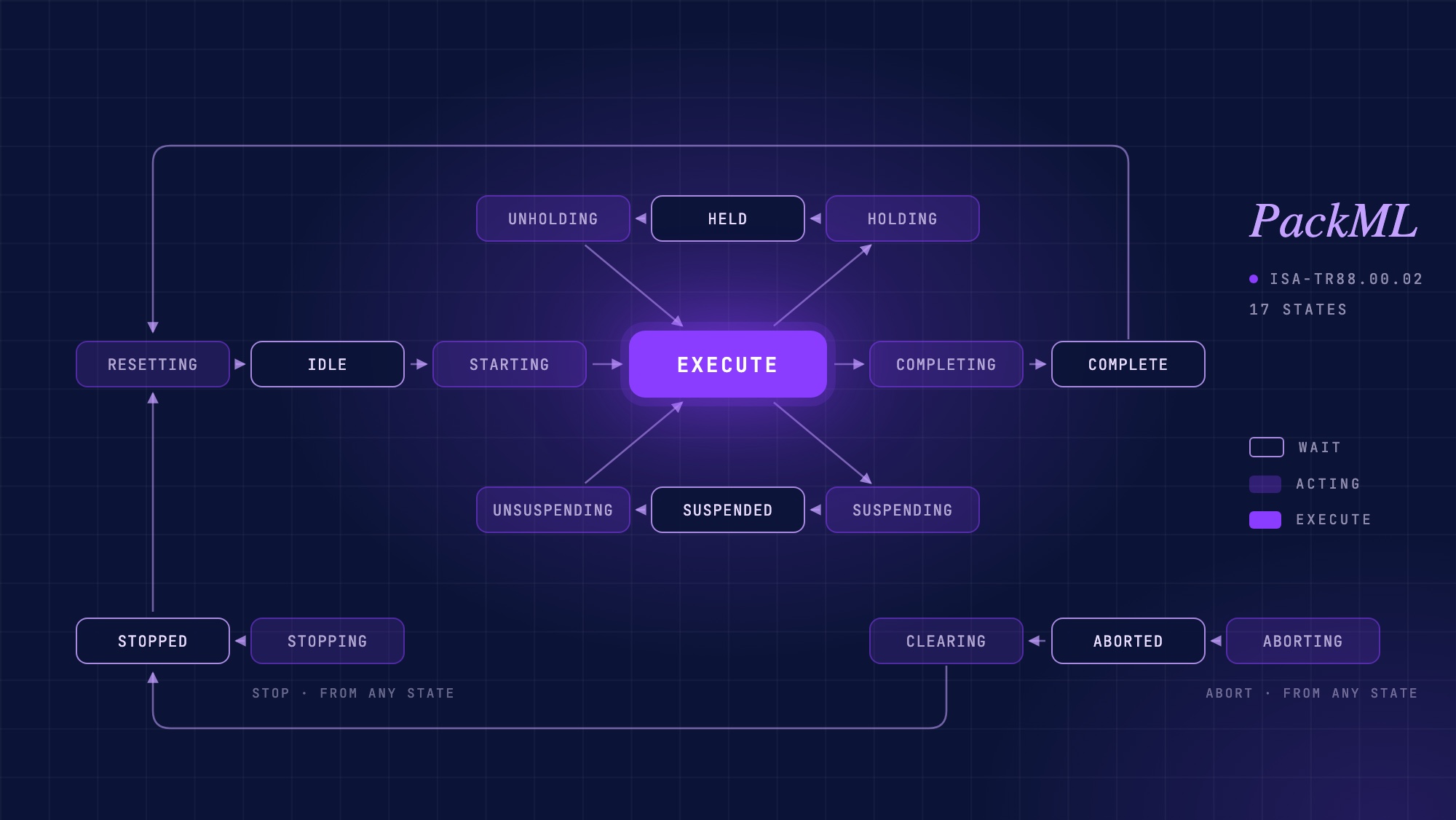
PackML explained: the state model, PackTags, and where AI fits
What PackML is, how the 17-state machine, modes and PackTags work, how to check whether a PLC project really follows it, and where AI helps.
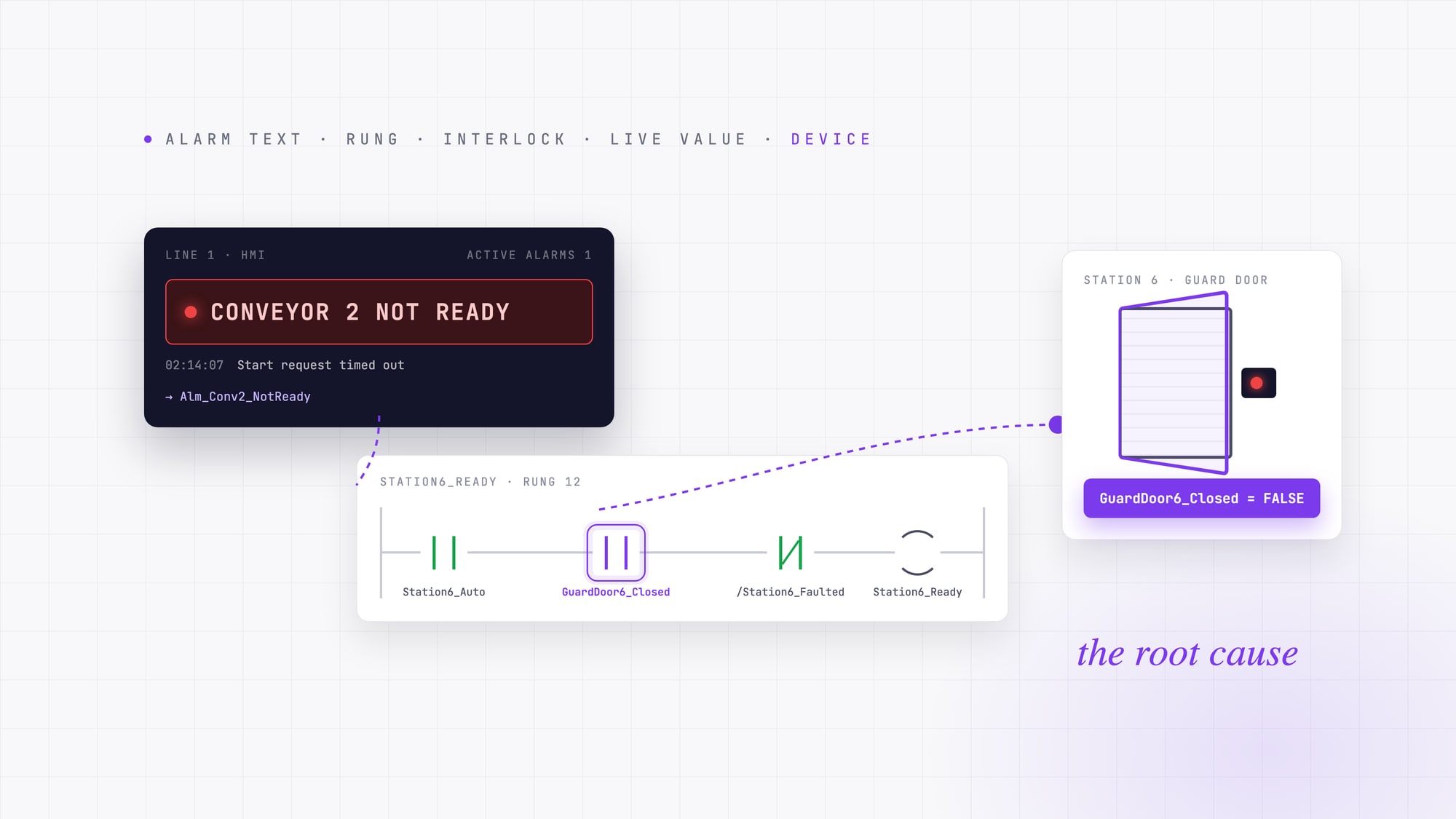
PLC fault codes and HMI alarms: how to trace an alarm back to its root cause
A PLC fault code or HMI alarm tells you where troubleshooting starts, not why the machine stopped. A field method for tracing an alarm from its text to the device behind it.
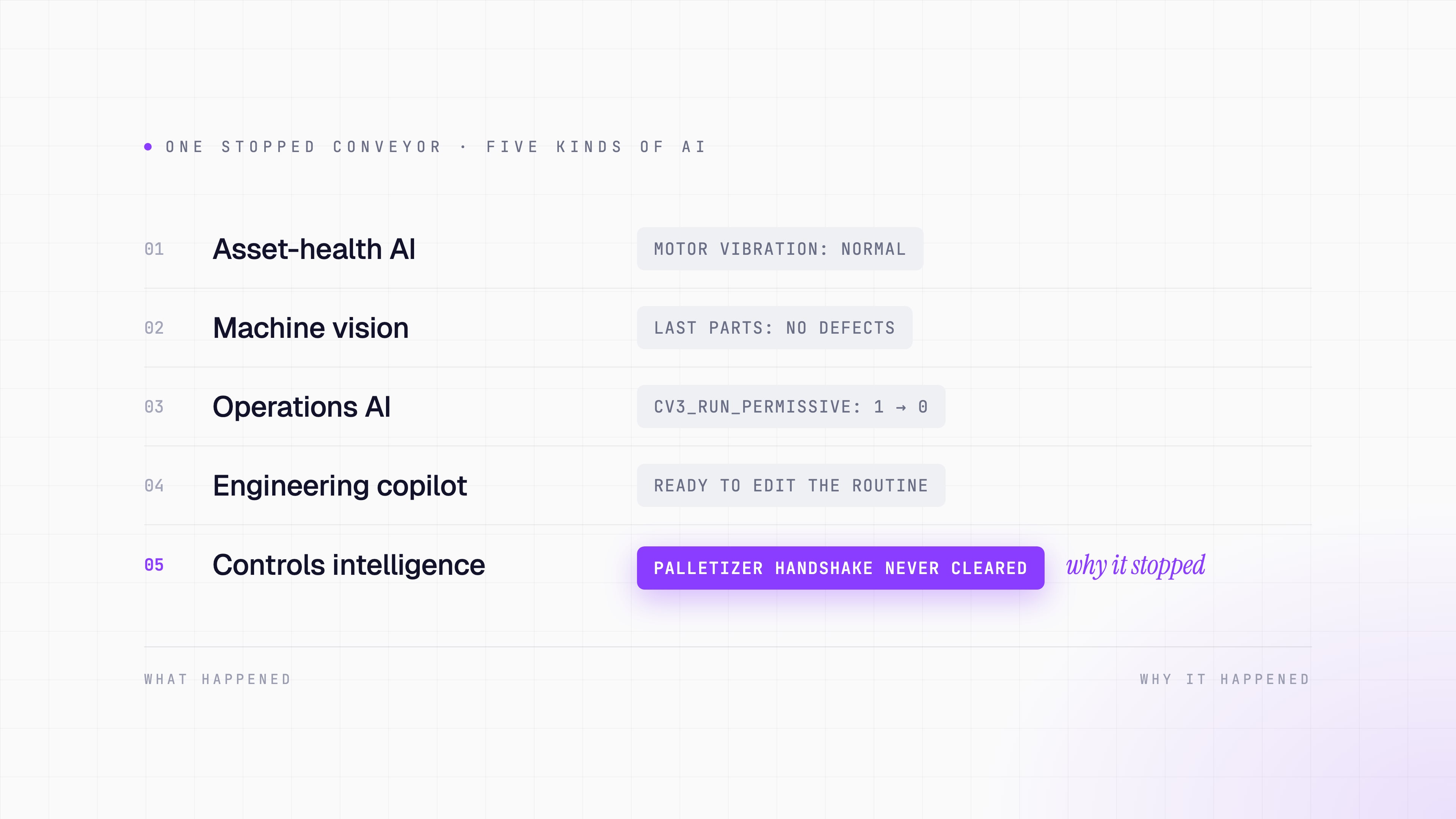
What is the best AI for industrial automation in 2026?
There is no single best AI for industrial automation. Compare industrial AI by the problem it solves, from machine vision to PLC troubleshooting.