
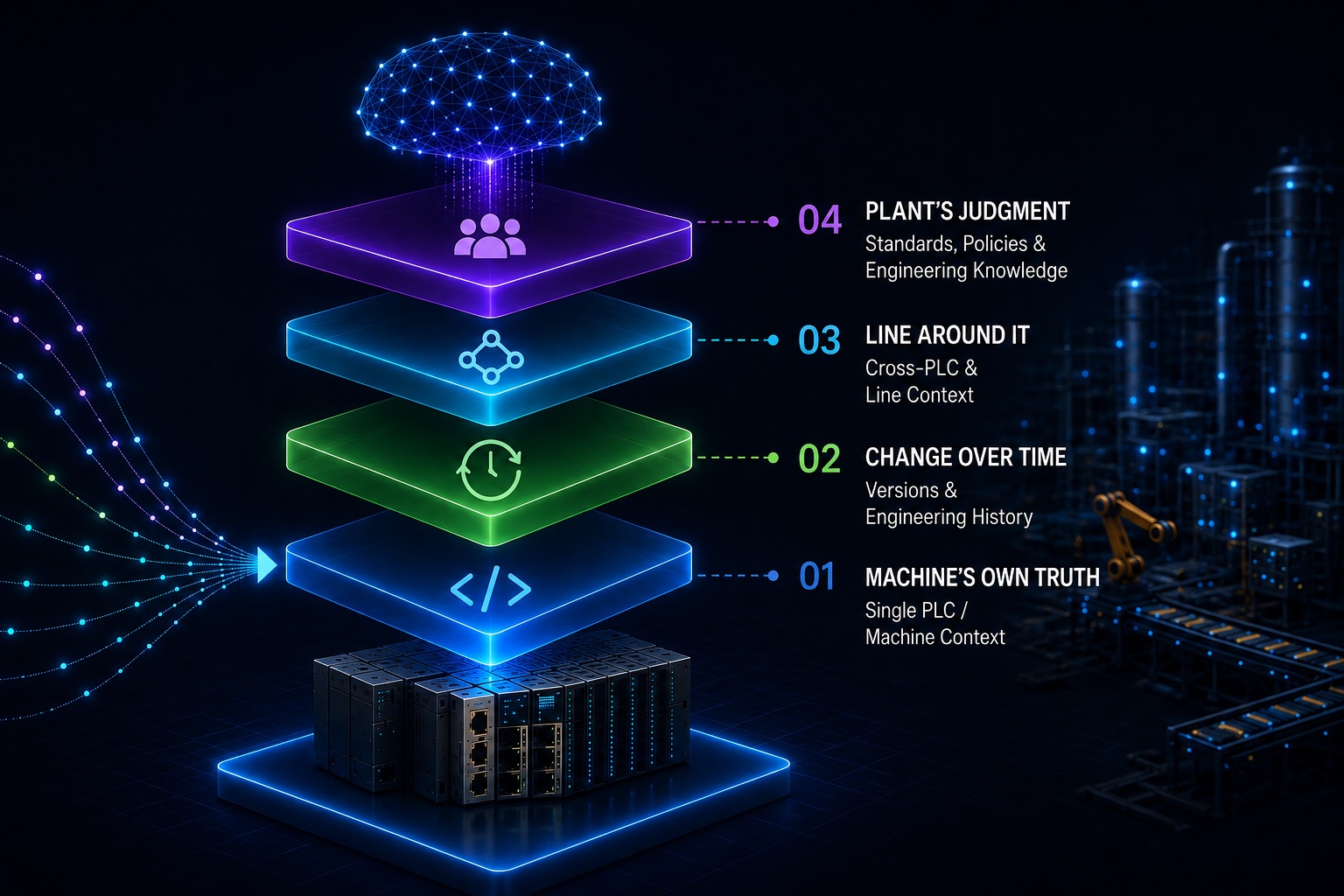
Ask an AI about your line and it answers from a database. It knows a tag changed value at 03:14. It does not know that the tag is an interlock, that the interlock was added after a guard door incident in 2019, that the station upstream holds product four seconds longer than the drawing says, or that your team never uses timers in that routine.
A controls engineer knows all of it. Not because the data was available. Because they were there.
Automation Context Layer · closest to the controller at the bottom
The machine's own truth
Single PLC / Machine Context
The code as the controller runs it, not as the drawing describes it.
- PLC project
- Structural graph
- Graphical logic
- Execution context
So it can answer: which rungs can hold this conveyor stopped, and what has to be true for each one?
Change over time
Versions & Engineering History
Every edit, who made it, and what the logic looked like before.
- Version history
- Change intelligence
- Logic lineage
- Engineering activity
So it can answer: this routine ran clean last quarter. What changed, and who changed it?
The line around it
Cross-PLC & Line Context
The station is not the system. The handshakes are.
- Cross-PLC relationships
- Machine handshakes
- Line sequences
- Operational signals
So it can answer: station 40 faulted. Did the fault start upstream?
The plant's judgment
Standards, Policies & Engineering Knowledge
How your plant does it, which is not always how the manual does it.
- Engineering standards
- Approved code examples
- Specifications and documentation
- Institutional knowledge
So it can answer: write this interlock the way we write interlocks here.
The right context. Resolved for every question. Scoped to the team and line allowed to see them.
Context changes the answer.
A model can know industrial automation.
Automation Context lets it understand your production system.
Every question is resolved against the relevant machine logic, engineering history, line relationships, operational signals, standards, and institutional knowledge, giving the model the context it needs to reason about what is actually happening in your plant.
Your project files stay yours. They are not used to train models and are not shared between customers.
Context resolves per question, scoped to the team and the line that person already has access to.
Every answer cites the routine, revision, or document it came from. Nothing arrives unsourced.
This complements your stack, not against it
Your historian records what happened. Your UNS moves it. Your asset model names it. None of them read the logic that caused it.
Automation Context adds the automation understanding that connects control logic with the broader industrial context. It reads the controller project and the decisions around it, then hands that up to whatever you already run. Nothing gets replaced. The missing layer gets added.
What each person gets out of it
A worked example
See the difference context makes.
Ask any AI the same question. What comes back depends entirely on what it knows about your plant.
"Why isn't this conveyor starting?"
Can explain how conveyors generally work.
Traces the start sequence, identifies the permissives, follows the interlocks and the upstream handshake, checks the downstream dependency, and points back to the exact rung behind the fault.
Same question. Different context.
Questions engineers actually ask
Context that describes what the plant does, not only what it recorded. It comes from the controller project itself, its revision history, the stations around it, and the standards and conventions your plant works to. PLCs.ai dynamically resolves the right combination for each question.
Upload a project, see the graph
Rockwell Studio 5000, Siemens TIA Portal, or CODESYS V3. No integration work. Ask the first question in minutes.
Start free trial →See the downtime math
Put your own line rate and fault frequency in. Get the cost of the diagnosis time you are spending now.
Open the calculator →