
The manufacturing AI adoption journey: from individual tools to enterprise intelligence.
AI adoption in manufacturing almost never starts as a transformation. It starts with one engineer, one PLC, and one AI model. What changes at each stage after that, from helping a maintenance tech at 2 AM to governing access across an entire enterprise, and why the infrastructure needed at the end looks nothing like where most manufacturers start.
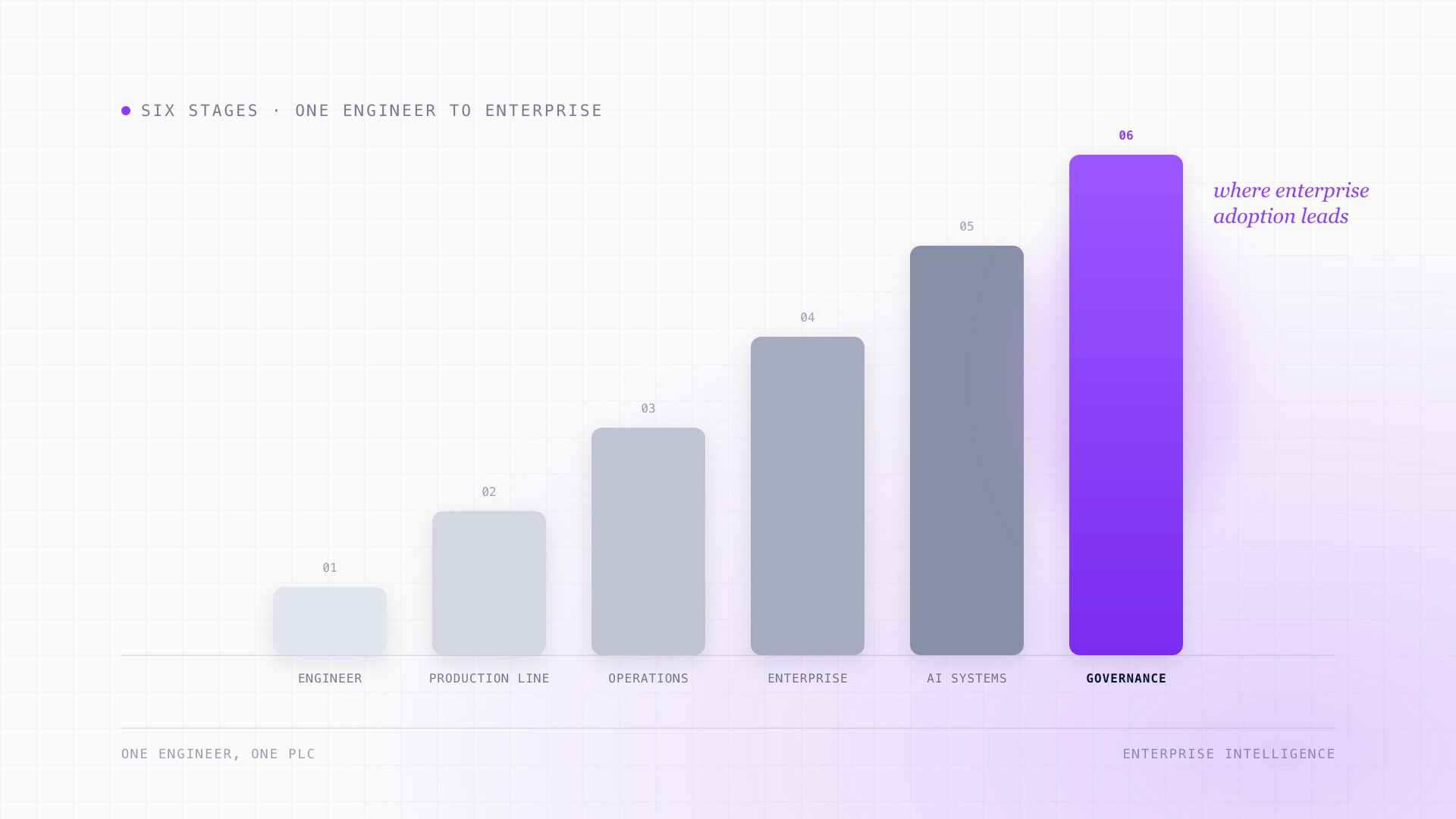
AI adoption in manufacturing rarely begins with an enterprise-wide transformation. It usually starts much smaller.
An automation engineer experiments with an LLM on a piece of PLC code. A controls team starts using an AI copilot inside its engineering environment. The investment is minimal, integration is almost nonexistent, and value can be demonstrated quickly.
That is a perfectly reasonable place to start.
But what happens when the organization wants more? What happens when the problem crosses multiple PLCs on a production line? What happens when AI needs to help not only the PLC expert, but the maintenance technician and the operator on the floor? Or when automation intelligence needs to become available to other applications, teams, and AI systems across the enterprise?
Each step increases the potential value of AI. It also increases the requirements.
The manufacturing AI adoption journey is not simply about deploying a better model. It is a progression from individual AI tools toward shared, integrated, and governed automation intelligence.
Stage 1: Experiment with AI
The easiest place to begin is with the individual engineer. Copy a section of ladder logic into an LLM and ask what it does. Use an AI assistant to generate Structured Text. Add a copilot to an engineering environment.
The barriers are extremely low. There is almost no enterprise integration required, and value can be demonstrated quickly. But the scope is equally limited. The AI typically works with one PLC at a time, often on a specific piece of code or a single project, and no broader automation context is being created or retained. That context stays inside the IDE or in the engineer's own head, assembled for the task at hand and largely disappearing once the task is done.
- 01Who benefits: individual controls and automation engineers.
- 02Scope: single PLC, single task.
- 03Context: engineer/IDE, task-specific and not persistent.
- 04Integration: minimal.
- 05Enterprise effort: minimal.
It is an excellent way to start experimenting with AI, but it remains primarily an individual engineering productivity tool. There is also more than one generation of tool available even at this stage.
The three generations of AI for PLC work, and how to tell them apart →The natural instinct at this stage is to just keep feeding the LLM more context: the whole routine, the whole project, every document you can find. That works, up to a point.
Why not just give an LLM more PLC context? →Stage 2: Move from the PLC to the production line
It doesn't take long for that same engineer to hit a wall, and it has nothing to do with who is using the AI. It is still just them. It is what the AI can see that runs out first.
Plants don't operate PLCs. They operate production lines.
A machine controlled by an Allen-Bradley PLC may be waiting for a condition generated by another Allen-Bradley PLC, or even by a Siemens PLC on another machine. Understanding either PLC independently may not explain why production has stopped.
AI now needs more than access to a project. It needs to understand relationships between PLCs, machines, vendors, signals, and dependencies as part of the same production system.
PLC → Machine → Production Line
And so does the infrastructure required to create and maintain it. This is where supporting multiple PLC vendors becomes very different from understanding a mixed-vendor production line, and it is worth its own deep dive. Notice that none of this required a new user, a new team, or a new piece of enterprise buy-in. One engineer, working alone, runs into it almost immediately.
Why industrial AI must understand the entire production line, not just one PLC →Stage 3: Extend AI to maintenance and operations
Once an engineer's AI understands the whole line rather than one PLC, a different kind of opportunity opens up: making that same understanding available to people who are not PLC experts at all.
Consider a maintenance technician trying to understand why a machine has stopped, or an operator on the floor watching an alarm they were never trained to interpret. The PLC expert may be able to open Studio 5000 or TIA Portal, navigate the project, and trace the logic. The technician and the operator usually cannot.
If AI is going to help them, that automation intelligence has to become available outside the engineering environment entirely, in whatever tool maintenance and operations already use, not inside an IDE. Now the requirements change: the organization needs a way to securely make that intelligence available, keep it current, interpret it correctly, and provide an interface designed for people who may never open an IDE.
The potential value increases again, because AI is no longer just improving the productivity of one expert working across a line. It is beginning to extend that expertise to everyone standing in front of the machine.
Stage 4: Connect automation intelligence to the enterprise
Once an organization builds useful automation context, another question emerges: why should that intelligence live inside one application?
A manufacturer may want automation insights available inside an asset-management system. Another team may want to incorporate them into an internal maintenance application. Operations may want selected information exposed through another interface.
Now the requirement moves from application access to platform access. APIs become important because the same automation intelligence needs to serve multiple applications and workflows. Repositories and existing document systems need to stay synchronized. Existing enterprise systems need to connect rather than creating another isolated information silo.
The value is no longer contained within the AI tool itself. The automation intelligence begins becoming part of the manufacturer's existing technology stack.
Stage 5: Make automation context available to other AI
The next step is particularly interesting.
Manufacturers are increasingly experimenting with their own LLMs, agents, and AI applications. But those systems face exactly the same problem: they don't inherently understand the plant's automation environment.
Giving every new AI application another collection of PLC files and documents recreates the context problem over and over again. Instead, the automation context can become reusable. Through standards such as MCP, enterprise AI systems can access the same structured understanding of PLCs, machines, production lines, documentation, and engineering knowledge.
An internal AI application might use the context to create a maintenance plan. Another might use it to analyze recurring production issues. A third might use it to build a new workflow or application around the plant's automation knowledge.
The model can change. The automation context remains.
Stage 6: Govern automation intelligence across the enterprise
Success creates another problem. More people now have access. More applications have access. More AI systems have access. And some of them may eventually do more than read.
At this point, access control cannot be an afterthought. The enterprise needs to determine who can access which plant, line, or PLC. Who can only read information, versus who can propose or make changes. What a contractor can access, and for how long. How users are authenticated through enterprise SSO. How actions, code changes, and engineering decisions are tracked. How organizational knowledge is preserved over time.
The journey has moved from AI functionality to enterprise governance. That is an essential distinction between experimenting with AI and operationalizing AI across manufacturing.
How far do you want this to go?
There is no reason a manufacturer needs to begin at Stage 6. Starting with an LLM or engineering copilot can be exactly the right first step.
But enterprises evaluating their longer-term AI strategy should ask a different question than which tool to buy: how far do we want this to go?
If the objective is to make one controls engineer more productive on a single PLC interaction, an engineering copilot may be sufficient. If the objective is to make automation intelligence available across maintenance, engineering, operations, applications, and enterprise AI systems, the requirements become fundamentally different.
- 01Multi-PLC and mixed-vendor context.
- 02Production-line understanding.
- 03Repository and document synchronization.
- 04Live automation context.
- 05Persistent engineering knowledge and documentation.
- 06APIs and enterprise integrations.
- 07MCP access for other AI systems.
- 08Roles, privileges, and access controls.
- 09SSO and temporary external access.
- 10Code-change history and governance.
These are not simply more features bolted onto an AI copilot. They are the infrastructure required to move AI from an individual engineering tool to an enterprise capability.
From AI tool to automation intelligence layer
The manufacturing AI adoption journey can start remarkably simply: one engineer, one piece of code, one AI model.
As adoption expands, almost every dimension changes. One PLC becomes a production line. One vendor becomes a mixed-vendor environment. One engineer becomes many users, on the plant floor and in maintenance. One application becomes many applications. One AI model becomes many AI systems. Temporary context becomes persistent organizational knowledge. And individual access becomes enterprise governance.
The technology required at the beginning of that journey does not necessarily look like the technology required at the end. That is why we believe the next generation of industrial AI will be about more than copilots.
The copilot can be where the journey starts. A shared automation intelligence layer is where enterprise adoption can lead.
PLCs.ai is built around taking manufacturers on the entire journey: automation context that starts at the PLC and expands to the production line, the enterprise, and the AI systems built on top of it. For us, this is the future, and it's available now.
How PLCs.ai builds Automation Context, layer by layer →More from the blog
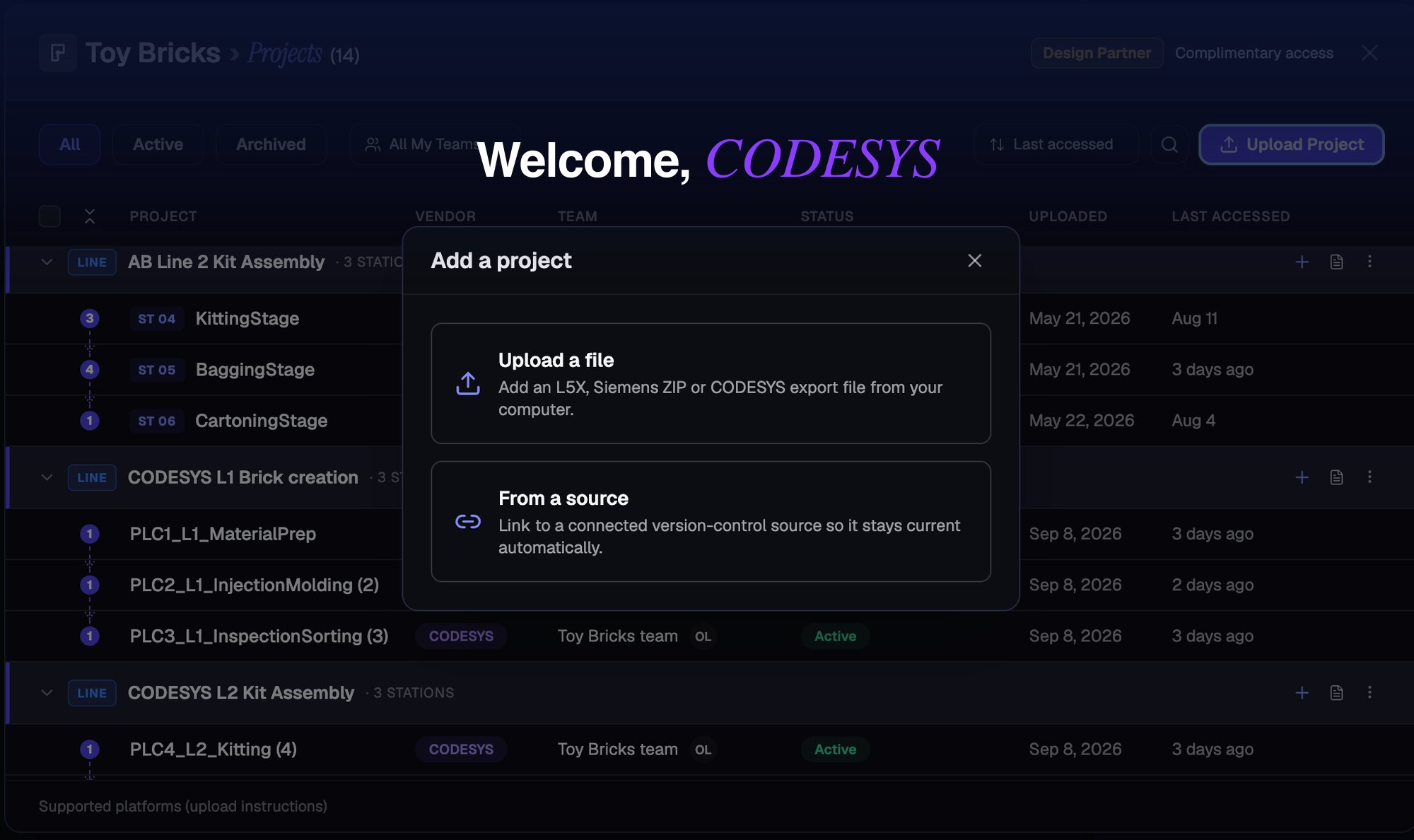
PLCs.ai now supports CODESYS V3 projects, across the entire CODESYS ecosystem.
PLCs.ai now supports CODESYS V3 projects, across first-party CODESYS environments and OEM platforms like WAGO, ABB, and Bosch Rexroth. A CODESYS export has no tag table and no hardware/IO tree, so getting there took real re-engineering, not just a new parser.
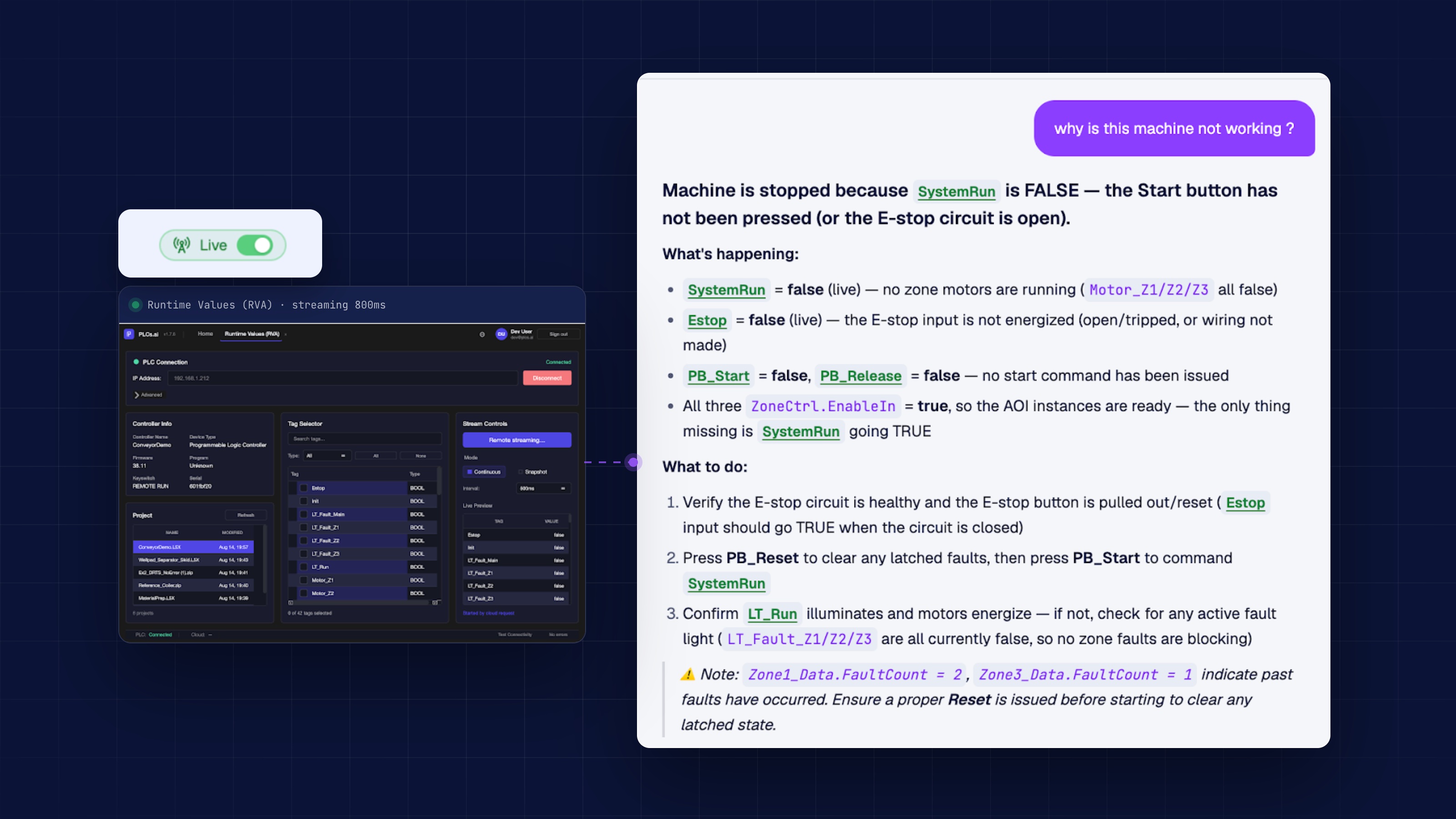
Runtime PLC data doesn’t just help troubleshooting. It multiplies it.
Reading the code tells you what a line is supposed to do. Runtime tag values tell you what it is actually doing right now. Troubleshooting needs both, and the gap between them is where most outages drag on.
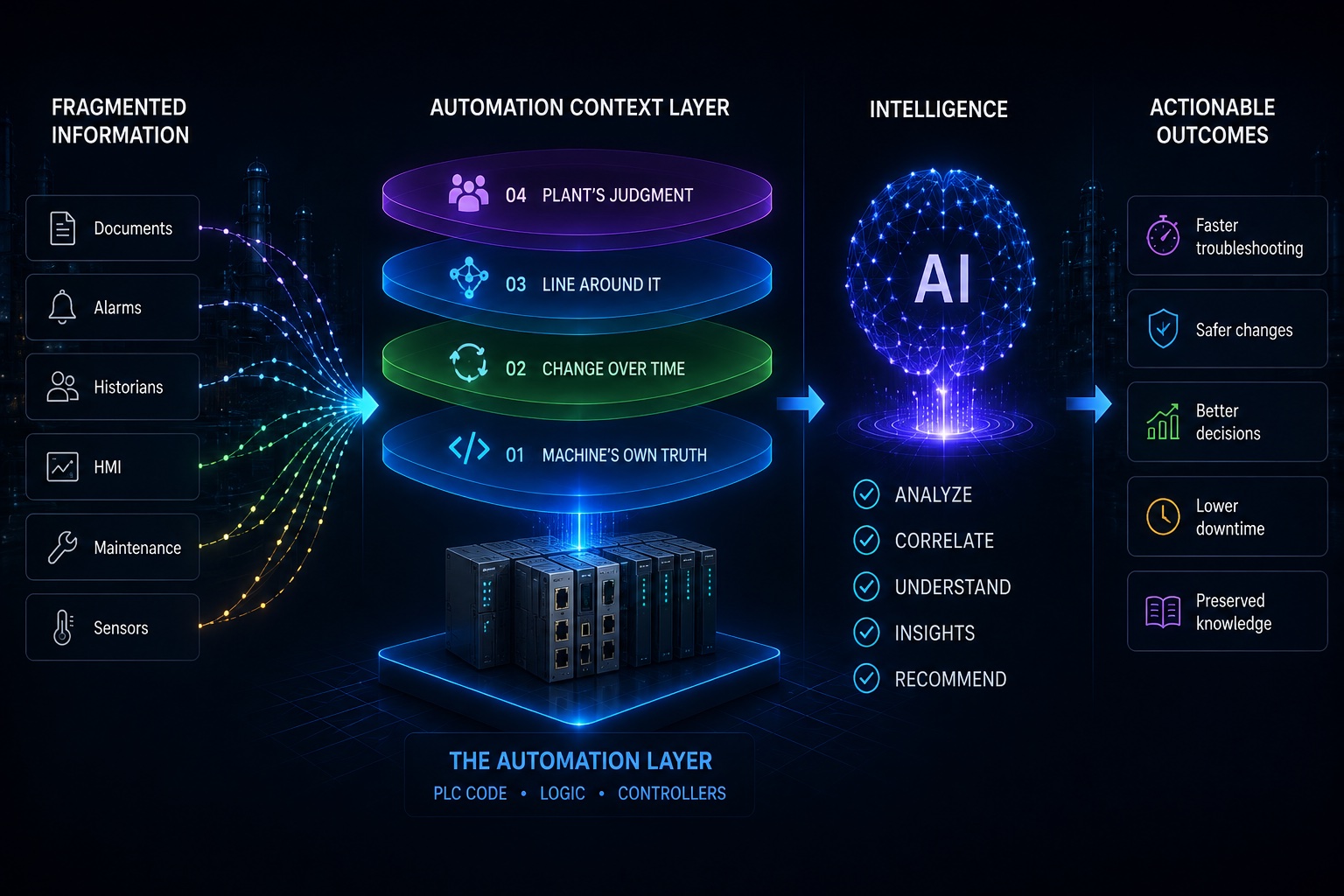
Industrial AI doesn’t have an intelligence problem. It has a context problem.
Today’s AI models are extraordinarily capable. But intelligence alone can’t tell you why a production line stopped, what an interlock protects, or what happens three stations downstream if an engineer changes a rung.