
The three generations of AI for PLC work: chatbots, file-aware AI, and live-plant AI.
AI for PLC work splits into three generations: chatbots that understand PLC concepts, file-aware AI that understands your project, and live-plant AI that understands what the automation system is doing right now. Knowing which one you are looking at changes what you can ask it.
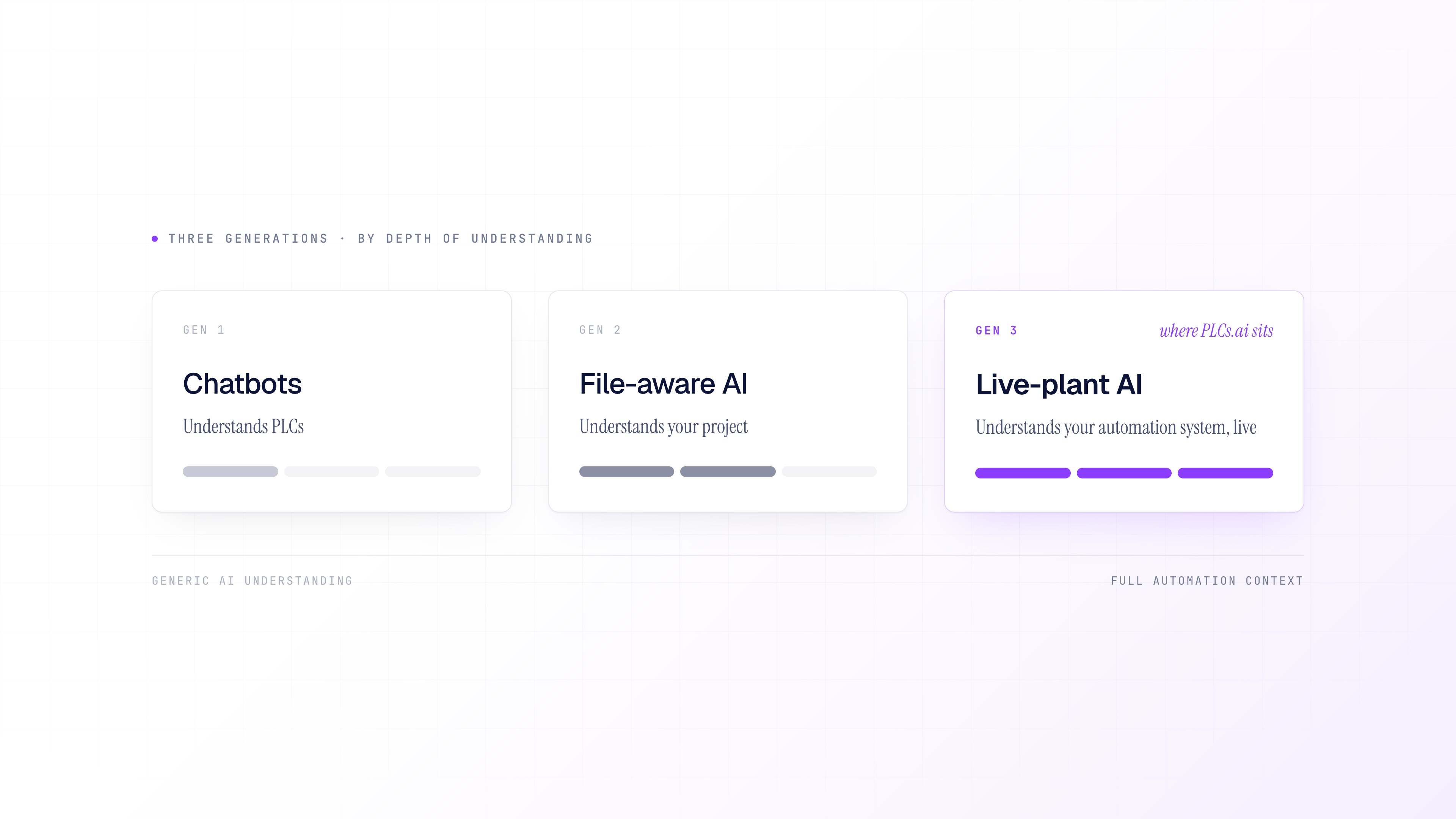
AI for PLC programming and troubleshooting is evolving through three distinct generations: general-purpose chatbots that understand PLC concepts, file-aware AI that understands your PLC project, and live-plant AI that understands what the automation system is actually doing.
Each generation adds something the previous one is missing: context. The difference matters because asking AI to write a rung of ladder logic is very different from asking it why a production line has stopped.
Understanding the three generations helps controls engineers, maintenance teams, and plant leaders choose the right level of AI for the problem they are trying to solve.
Generation 1: what are general-purpose AI chatbots for PLC work?
Generation 1 uses general-purpose AI models such as ChatGPT, Claude, and Gemini to answer PLC questions, explain code, and generate logic from information provided in a prompt. They understand PLC concepts well, but they only know the automation context that the user gives them.
General-purpose AI has made PLC knowledge dramatically more accessible. An engineer can paste a piece of Structured Text or describe a control sequence and ask:
- 01What does this code do?
- 02Explain this ladder logic.
- 03Write Structured Text for a motor sequence.
- 04How should I structure this state machine?
- 05What could cause this timer not to reset?
- 06Explain the difference between these PLC instructions.
For learning, brainstorming, syntax questions, code examples, and quick sanity checks, this can be extremely useful. It also gives people who are not PLC experts a much easier way to ask questions about industrial automation.
The limitation is not necessarily the intelligence of the AI model. It is context. A chatbot sees what you put into the conversation: paste one rung, and it sees one rung, with no inherent knowledge of where those tags are written elsewhere in the project, which routines call which programs, how the machine sequence works, or what another PLC on the line is doing. It also has no automatic knowledge of your plant's programming standards, previous versions of the project, approved engineering patterns, or the current state of the running machine.
That makes Generation 1 very useful for questions about PLCs, but much less suited to questions that require understanding a specific automation system. It is a good fit for learning PLC programming concepts, explaining isolated code, generating example logic, brainstorming approaches, syntax and programming questions, and quick engineering sanity checks.
The AI understands PLCs, but it does not inherently understand your PLC.
Generation 2: what is file-aware AI for PLCs?
Generation 2 moves from pasted code to complete PLC project context. File-aware AI can ingest a PLC project or project export and reason across routines, tags, data structures, cross-references, and dependencies instead of analyzing individual fragments in isolation. This is a major step forward.
Once AI can understand a complete project, engineers can ask much more useful questions:
- 01What conditions prevent this motor from starting?
- 02Where is this tag written?
- 03Which routines affect this alarm?
- 04Explain the complete sequence for this machine.
- 05What is this Add-On Instruction doing?
- 06Which permissives must be true before this step executes?
- 07What changed between these project versions?
- 08Which logic is relevant to this fault?
Instead of manually navigating hundreds or thousands of rungs, tags, blocks, and cross-references, the AI can use the complete project structure to find the relevant relationships. This is particularly valuable for troubleshooting and legacy equipment, where the person investigating the machine may not have written the original program.
PLC logic is highly interconnected: a rung may reference a tag whose value is determined in another routine, that routine may call an Add-On Instruction or function block, and the behavior may depend on a sequence defined elsewhere in the project. Looking at the rung alone can therefore produce a technically correct explanation that misses the actual engineering relationship. File-aware AI can follow those relationships.
Generation 1 understands the code you show it. Generation 2 understands the project the code belongs to.
A PLC project describes how the machine is designed to behave. It does not necessarily tell the AI what the machine is doing at this exact moment. Suppose five permissives must be true for a conveyor to start: with the complete project, Generation 2 can identify all five conditions and explain exactly how they control the conveyor, but without current runtime values, it may not know which of those five conditions is false on the running machine right now.
That distinction becomes particularly important during troubleshooting. File-aware AI can dramatically narrow the investigation and explain the logic behind a problem. Runtime context can take the next step by showing which condition is actually occurring.
File-aware PLC AI is a strong fit for understanding unfamiliar PLC projects, troubleshooting from control logic, documenting legacy systems, tracing tags and dependencies, analyzing sequences and interlocks, comparing project versions, reviewing and modifying existing logic, and reducing dependence on the original PLC programmer.
The AI understands your PLC project, but it does not necessarily know what the machine is doing right now.
Generation 3: what is live-plant AI?
Generation 3 combines PLC engineering context with the state of the running automation system. Live-plant AI can reason across complete PLC projects, multiple controllers, engineering history, plant standards, and runtime values to connect what the logic says should happen with what the machine is actually doing. This moves AI from project understanding toward automation understanding.
Consider the same conveyor example. Generation 1 can explain how a permissive works if you provide the relevant code. Generation 2 can analyze the complete project and identify all five permissives required for the conveyor to start. Generation 3 can potentially see that four are currently true and one is false, trace that condition through the control logic, and explain what is preventing the conveyor from running.
The troubleshooting question changes from "What could prevent this conveyor from starting?" to "What is preventing this conveyor from starting right now?" That is a significant difference.
Production lines are systems, but PLC engineering tools have historically been organized around individual controllers. The machine that has stopped may be waiting for another machine. A downstream controller may be blocking an upstream sequence. A handshake may be missing between two PLCs. Different parts of the same line may even use controllers from different vendors. Understanding the fault therefore requires context beyond one project. Live-plant AI can combine:
- 01Complete PLC project logic.
- 02Multiple PLCs across the production line.
- 03Mixed-vendor automation.
- 04Engineering versions and history.
- 05Plant standards and approved patterns.
- 06Organizational engineering knowledge.
- 07Current PLC tag values and runtime information.
- 08Allen-Bradley / Rockwell Automation, Siemens, and CODESYS V3 environments, with Schneider Electric support coming soon.
Every plant has engineering knowledge that does not live inside the PLC program: programming standards, naming conventions, approved architectures, operating procedures, historical engineering decisions, and lessons learned by experienced controls engineers. AI that understands only PLC code sees only part of the system. Adding organizational knowledge allows the AI to reason not only about whether logic is syntactically valid, but whether a proposed approach is consistent with how that organization expects its automation to be engineered.
Traditional PLC troubleshooting requires someone to combine several forms of information manually: understanding the code, navigating the project, inspecting live values, knowing how the machine operates, understanding interactions with other equipment, and often remembering plant-specific engineering practices. Generation 3 brings those sources of context together. That does not eliminate engineering judgment. It gives the engineer or technician a much more complete starting point for that judgment.
The AI understands the automation system and what it is doing now.
How do the three generations of PLC AI compare?
| Capability | Gen 1: Chatbots | Gen 2: File-aware AI | Gen 3: Live-plant AI |
|---|---|---|---|
| Project visibility | Only supplied fragments | Complete project | Complete project |
| Line-level reasoning | No native context | Depends on platform | Multi-PLC / line context |
| Live machine state | No | No | Yes |
| Organizational knowledge | Only if manually supplied | Depends on platform | Plant standards, history, and engineering context |
| Safety and review workflow | General-purpose | Depends on platform | Designed around industrial engineering workflows |
The generations are not simply a ranking of bad, better, best. They solve different problems: a chatbot may be all an engineer needs to understand an instruction or generate a small example, file-aware AI becomes much more valuable when the task involves a real PLC project, and live-plant AI becomes important when the question depends on what is happening across the actual production system.
Where does PLCs.ai fit?
PLCs.ai is being built around the Generation 3 model: an AI intelligence and context layer for industrial automation that combines PLC project understanding with broader production-line and runtime context. The foundation is complete PLC project understanding rather than isolated code snippets. From there, the context expands across:
- 01PLCs and machines on the production line.
- 02Allen-Bradley / Rockwell Automation, Siemens, and CODESYS V3 environments, with Schneider Electric support coming soon.
- 03Project versions and engineering history.
- 04Organizational standards and engineering knowledge.
- 05Runtime PLC information.
This allows the same platform to support different levels of interaction, from explaining unfamiliar PLC logic to helping investigate why a production system is behaving the way it is. The goal is not to replace Studio 5000, TIA Portal, or the controls engineer. It is to create an intelligence layer across the automation environment that makes the knowledge inside those systems accessible to more of the people responsible for keeping production running.
What does live-plant AI mean for troubleshooting?
The biggest difference is the ability to connect logic with state. A static PLC project tells you these are the conditions required for this machine to run. Runtime information tells you these are the conditions that are true and false right now. Combining the two lets AI help move troubleshooting from identifying possible causes toward identifying the conditions actually responsible for the current behavior.
For production environments, that can mean less time navigating PLC projects, less dependence on a particular controls expert, and a faster path from a stopped machine to the relevant logic.
See how runtime PLC data multiplies troubleshooting →What is automation context?
Automation context is the information required to understand PLC logic as part of the larger production system rather than as isolated code. It can include the PLC project, machine relationships, other controllers, engineering history, company standards, documentation, and runtime signals.
The more of that context an AI system understands, the more meaningful its answers can become. A model that understands a rung can explain a rung. A model that understands a project can explain the machine logic around it. A model that understands the production line and its current state can reason about what the automation system is actually doing.
How PLCs.ai builds Automation Context, layer by layer →How should you choose between the three generations?
Match the level of AI to the job you need it to do, not to the most impressive demo.
- 01To learn a PLC concept, check syntax, or generate an isolated example, a general-purpose chatbot may be enough.
- 02To understand, document, or troubleshoot an actual PLC project, full-project context becomes much more important.
- 03If your problem spans multiple machines, controllers, or vendors, or depends on current machine state, look for a system capable of line-level and runtime context.
The question is not simply "does this tool use AI?" The more useful question is "what does this AI actually know about my automation system when I ask it a question?"
What are the types of AI for PLC programming?
PLC AI can be viewed in three generations: general-purpose chatbots that understand PLC concepts and supplied code, file-aware AI that understands complete PLC projects, and live-plant AI that combines engineering context with multiple controllers, plant knowledge, and runtime information.
What is the difference between a PLC copilot and live-plant AI?
A PLC copilot generally assists an engineer with programming or understanding a PLC project. Live-plant AI extends beyond the individual engineering project by combining PLC logic with broader production-line context and current information from the running automation system.
Can AI see what a PLC is doing in real time?
AI can reason about real-time PLC behavior when the system has access to runtime PLC data. Combining live tag values with the underlying control logic allows the AI to connect current machine state with the program that governs it.
The bottom line
Generation 1, understands PLCs → Generation 2, understands your PLC project → Generation 3, understands your automation system and what it is doing now
Each step adds context, and context determines how useful AI can be when the question moves from writing code to solving a real production problem.
What is PLC AI? The five types of tools and where PLCs.ai fits →The complete PLC troubleshooting guide →More from the blog
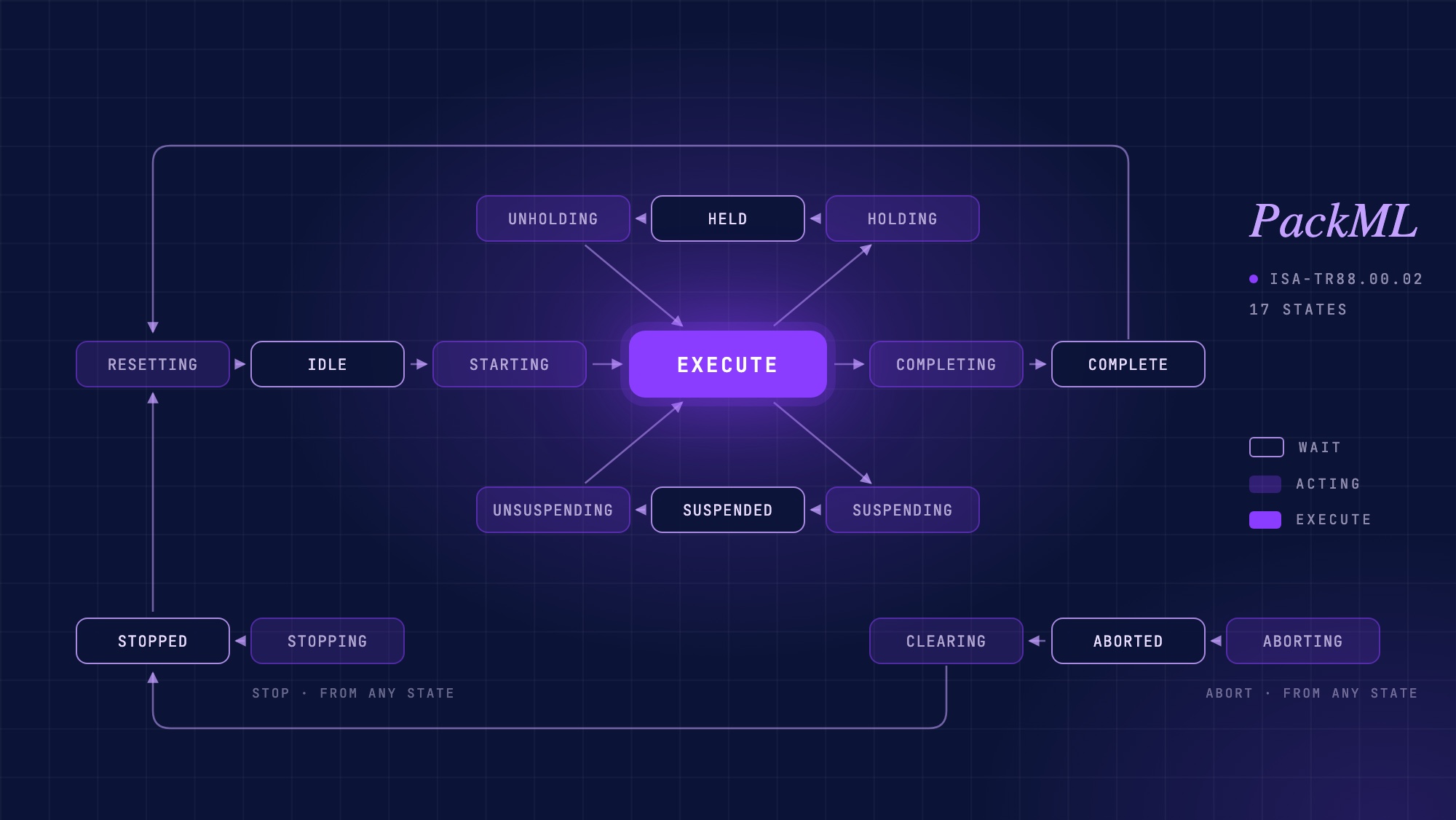
PackML explained: the state model, PackTags, and where AI fits
What PackML is, how the 17-state machine, modes and PackTags work, how to check whether a PLC project really follows it, and where AI helps.
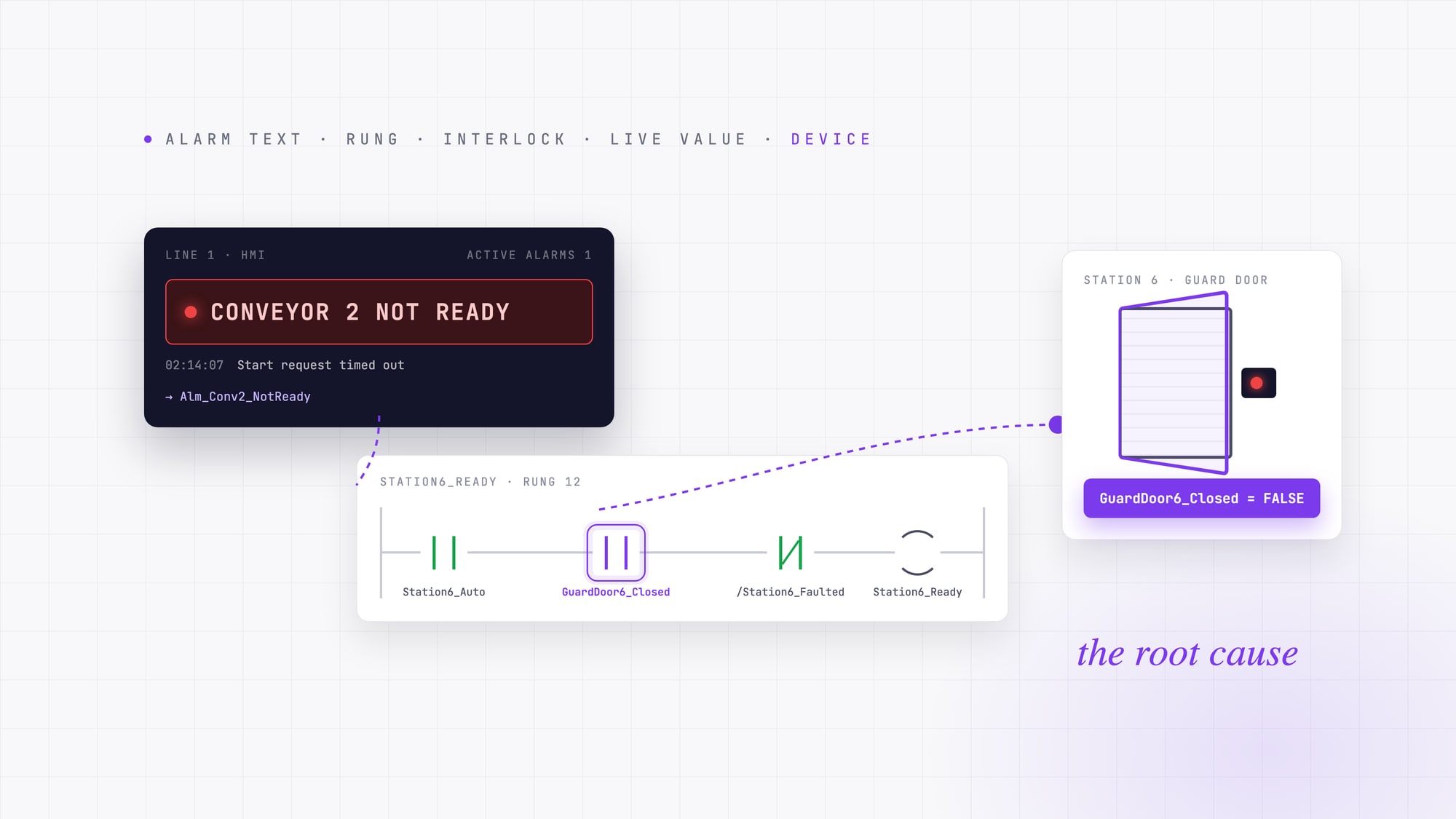
PLC fault codes and HMI alarms: how to trace an alarm back to its root cause
A PLC fault code or HMI alarm tells you where troubleshooting starts, not why the machine stopped. A field method for tracing an alarm from its text to the device behind it.
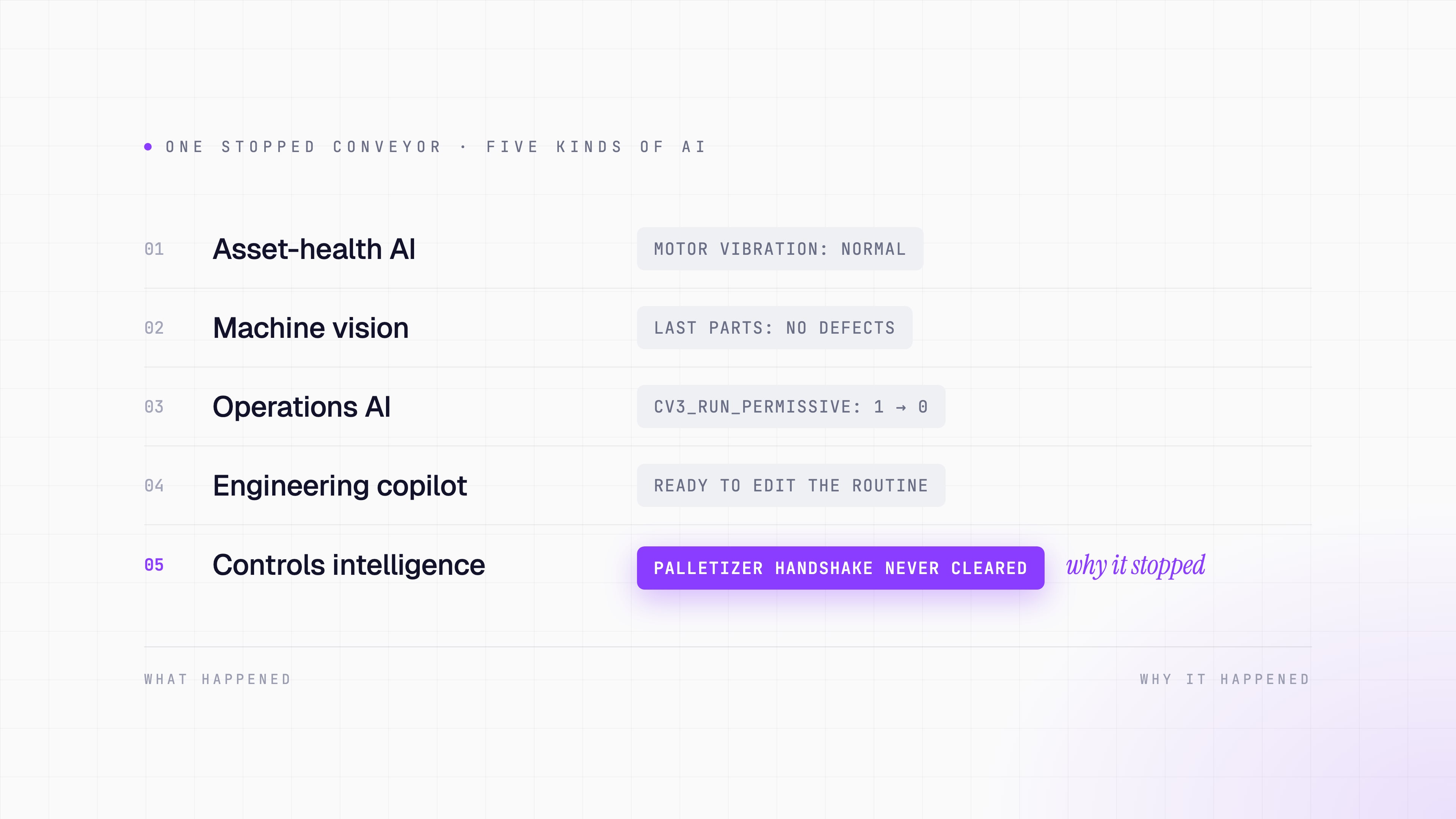
What is the best AI for industrial automation in 2026?
There is no single best AI for industrial automation. Compare industrial AI by the problem it solves, from machine vision to PLC troubleshooting.