
Why industrial AI must understand the entire production line, not just one PLC.
Production lines are rarely single-vendor. A stopped machine on an Allen-Bradley PLC can be waiting on a permissive that only makes sense once you look at the Siemens PLC next to it. What mixed-vendor line context means, why it is different from simply supporting multiple PLC vendors, and how AI can trace a fault across both sides of that handshake.

Industrial automation does not operate one PLC at a time. Production lines are systems of machines, controllers, people, standards, and live signals working together. For AI to meaningfully support industrial operations, it needs context across that entire environment, not just the code inside a single controller.
This becomes especially important in real manufacturing plants, where a production line may contain Allen-Bradley / Rockwell Automation PLCs, Siemens PLCs, other PLC vendors, legacy equipment, machines from different OEMs, and automation added at different points over many years.
A problem that appears on one machine may originate somewhere else entirely. That is why the next generation of industrial AI needs to understand the production line as a system.
Why isn't understanding one PLC enough?
A PLC project contains a tremendous amount of information about a machine: sequences, interlocks, permissives, alarms, timers, state logic, I/O, and the conditions required for equipment to operate. But the boundary of a PLC project is not necessarily the boundary of the problem.
Consider a packaging line where one machine is waiting for permission from the machine downstream. The local PLC may be operating exactly as designed. Its logic says:
Do not continue until the downstream machine is ready.
Understanding only that PLC might tell you why the machine is waiting. Understanding the line can tell you what it is waiting for, which controller owns that condition, and why that condition has not been satisfied. That distinction becomes critical during troubleshooting.
What is line-level PLC context?
Line-level PLC context means understanding multiple controllers and machines as parts of one connected automation system rather than treating each PLC project independently. That context can include:
- 01The complete logic inside each PLC.
- 02Relationships between machines.
- 03Controller-to-controller handshakes.
- 04Shared tags and signals.
- 05Upstream and downstream dependencies.
- 06Production sequences and live PLC values.
- 07Project versions, engineering history, and plant standards.
The goal is not simply to collect more PLC projects. It is to understand the relationships between them.
Why do mixed PLC vendors make this more important?
Many manufacturing environments are not single-vendor environments. A manufacturer may have Allen-Bradley / Rockwell Automation equipment on one machine, Siemens equipment elsewhere on the same line, or other PLC vendors entirely. Vendor-native engineering tools are naturally centered on their own ecosystems, but the manufacturer has to operate the whole production environment, regardless of which company supplied each controller.
The production problem does not care which logo is on the PLC. If an Allen-Bradley-controlled machine is waiting for a condition originating from a Siemens-controlled machine, troubleshooting requires understanding both sides of that interaction. This is where vendor-agnostic automation context becomes important.
Can AI troubleshoot across Allen-Bradley and Siemens PLCs?
Yes, if the AI platform can understand projects from both environments and reason about them as part of the same production system. The important capability is not simply supporting two PLC vendors independently. There is a significant difference between:
I can analyze an Allen-Bradley PLC and I can analyze a Siemens PLC.
I can understand how the Allen-Bradley and Siemens PLCs interact as part of the same production line.
The second requires line context. For example, imagine a filler on an Allen-Bradley PLC that will not index because Upstream_Ready is false. Analyzing the filler's project shows exactly which permissive is missing, but not why.
Understanding the line lets the investigation continue upstream into the capper, which sets that condition and runs on a Siemens PLC. Runtime context can then close the loop: not just that the capper is withholding the permissive, but that it is doing so because a torque fault on Cap_Head_3 has been sitting unacknowledged for eleven minutes.
That is the difference between explaining a stopped machine and finding the fault that actually caused it, on a controller that was never loaded into the same engineering software as the machine that stalled.
Why vendor-neutral AI matters to manufacturers
PLC vendors have strong incentives to make their own engineering ecosystems more intelligent. That is valuable. But manufacturers face a different problem: their automation environment may include multiple PLC vendors, different generations of controllers, equipment from many OEMs, internal controls engineers, external system integrators, contractors, different plant standards, and decades of engineering history. The manufacturer's operational reality is the combination of all of them.
That creates an important role for a vendor-neutral intelligence layer. Instead of asking "How can AI make this PLC engineering environment smarter?" the manufacturer can ask "How can AI understand our automation environment?" Those are not the same question.
Why does this matter when experienced PLC engineers aren't available?
Mixed-vendor lines make this worse, not better: the person on shift may know the Allen-Bradley side of the line well and the Siemens side barely at all, or vice versa. A vendor-neutral context layer does not require whoever is standing at the stopped machine to already be fluent in both ecosystems.
That is a related but separate problem from what happens when the one engineer who understands a line retires or leaves.
What happens when your best PLC engineer retires? →Production context and the automation hierarchy
Even understanding every PLC on the line is only part of the picture. Manufacturing knowledge also exists in the organization around the automation: why a sequence was designed a certain way, what standards a corporate automation team expects, and what access a system integrator should have to one line without seeing the rest of the plant.
That is a different layer of context than the multi-vendor, line-level reasoning this article is about, and it deserves its own explanation rather than a summary here.
What an automation context layer actually looks like →Where does PLCs.ai fit?
PLCs.ai is being built as a vendor-agnostic intelligence and context layer across industrial automation. Rather than limiting AI to one code fragment, one PLC project, or one automation vendor, PLCs.ai is designed to expand context across the production environment.
Today, that includes Allen-Bradley / Rockwell Automation, Siemens, and CODESYS V3 environments, allowing projects from both ecosystems to become part of the same broader automation context. Support for Schneider Electric PLC environments is coming soon.
PLCs.ai organizes that automation context around the way manufacturers actually operate:
Organization → Team → Production line → PLC
This creates a foundation for understanding individual PLC projects while also reasoning across multiple controllers and mixed-vendor production environments. Runtime PLC data adds another dimension by connecting the engineering logic with what the machine is actually doing.
Don't make each PLC smarter in isolation. Give the organization an intelligence layer that understands the automation system around them.
What should manufacturers look for in AI for production automation?
The right question is not simply whether an AI tool can generate PLC code. Manufacturers evaluating industrial AI should ask:
- 01Can it understand a complete PLC project?
- 02Can it understand multiple PLCs together?
- 03Can it reason across machines on the same production line?
- 04Can it work across different PLC vendors?
- 05Can it combine engineering logic with live PLC values?
- 06Can it incorporate plant standards and engineering knowledge?
- 07Can access and context be controlled for different teams, contractors, and system integrators?
The answers determine whether the AI understands PLC code, or whether it can begin to understand the automation environment.
Can AI troubleshoot multiple PLCs at the same time?
Yes. An AI platform with multi-PLC context can analyze relationships across controllers rather than treating each PLC project independently. This is particularly useful when faults involve handshakes, interlocks, or dependencies between machines.
Can AI troubleshoot a production line with different PLC brands?
Yes, provided the AI platform supports the relevant PLC environments and can reason across them as one production system. PLCs.ai currently supports Allen-Bradley / Rockwell Automation, Siemens, and CODESYS V3 environments, with Schneider Electric support coming soon.
Why is mixed-vendor PLC support important?
Manufacturing plants often operate equipment from different vendors. A production problem can cross those vendor boundaries, so an AI system limited to one vendor may only see part of the automation context.
What is multi-PLC troubleshooting?
Multi-PLC troubleshooting means investigating a production problem across the logic and dependencies of more than one controller. Instead of stopping at the PLC where the symptom appears, the investigation can follow signals and conditions into other controllers and machines.
What is the difference between multi-vendor support and mixed-vendor line context?
Multi-vendor support means a platform can understand projects from different PLC vendors. Mixed-vendor line context goes further: it understands how those different PLCs and machines relate to each other as part of the same production system.
The bottom line
Factories operate production lines, not isolated PLC projects. As industrial AI moves deeper into manufacturing operations, understanding individual PLCs will not be enough.
The AI needs to understand how machines interact, how PLCs depend on one another, how different vendors coexist, what the equipment is doing now, and how the organization around that equipment works.
That is the difference between AI for PLC code and AI for the automation system. And for manufacturers operating complex, mixed-vendor environments, that difference matters.
How PLCs.ai reads a whole production line, not just one project →More from the blog
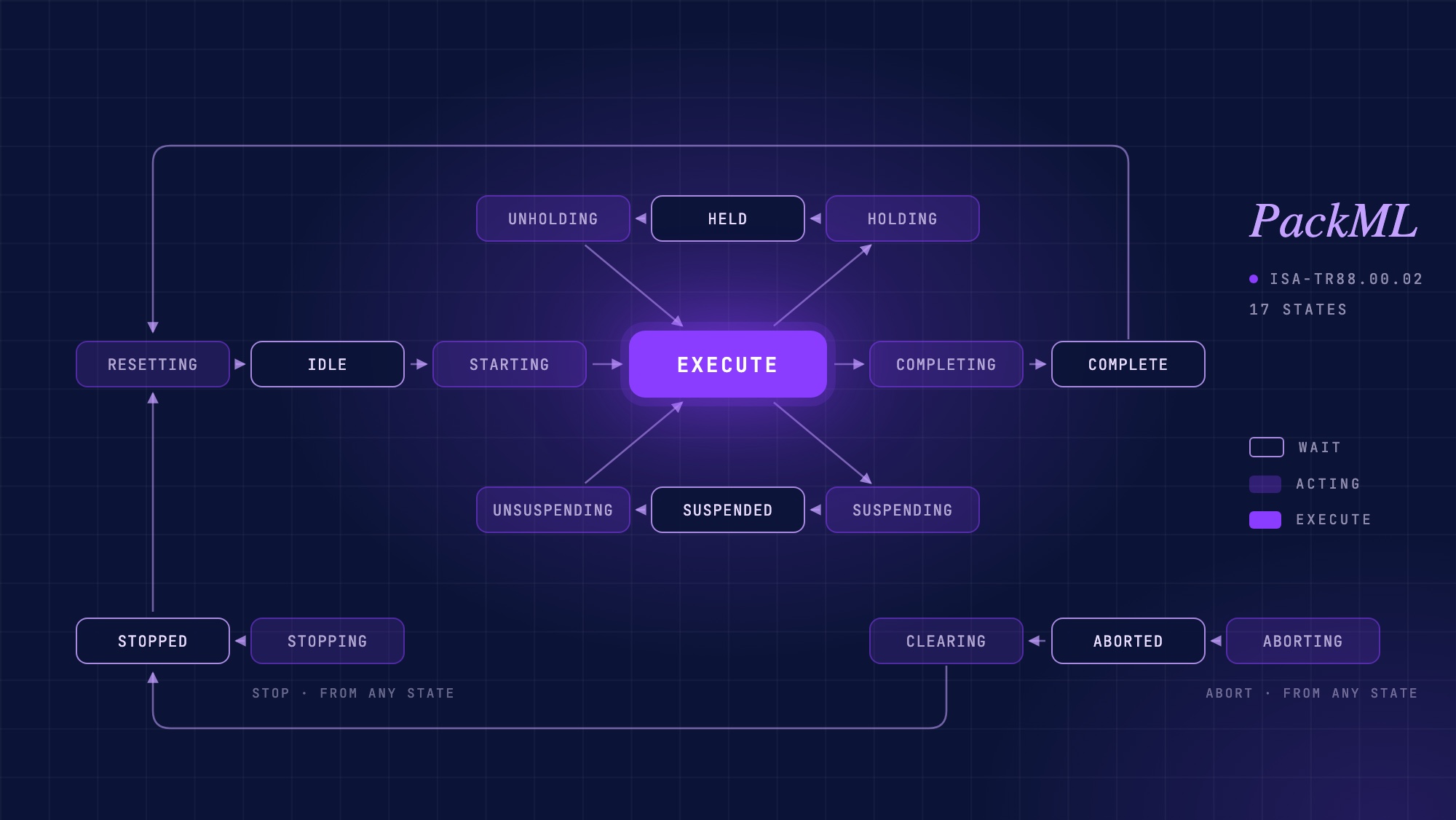
PackML explained: the state model, PackTags, and where AI fits
What PackML is, how the 17-state machine, modes and PackTags work, how to check whether a PLC project really follows it, and where AI helps.
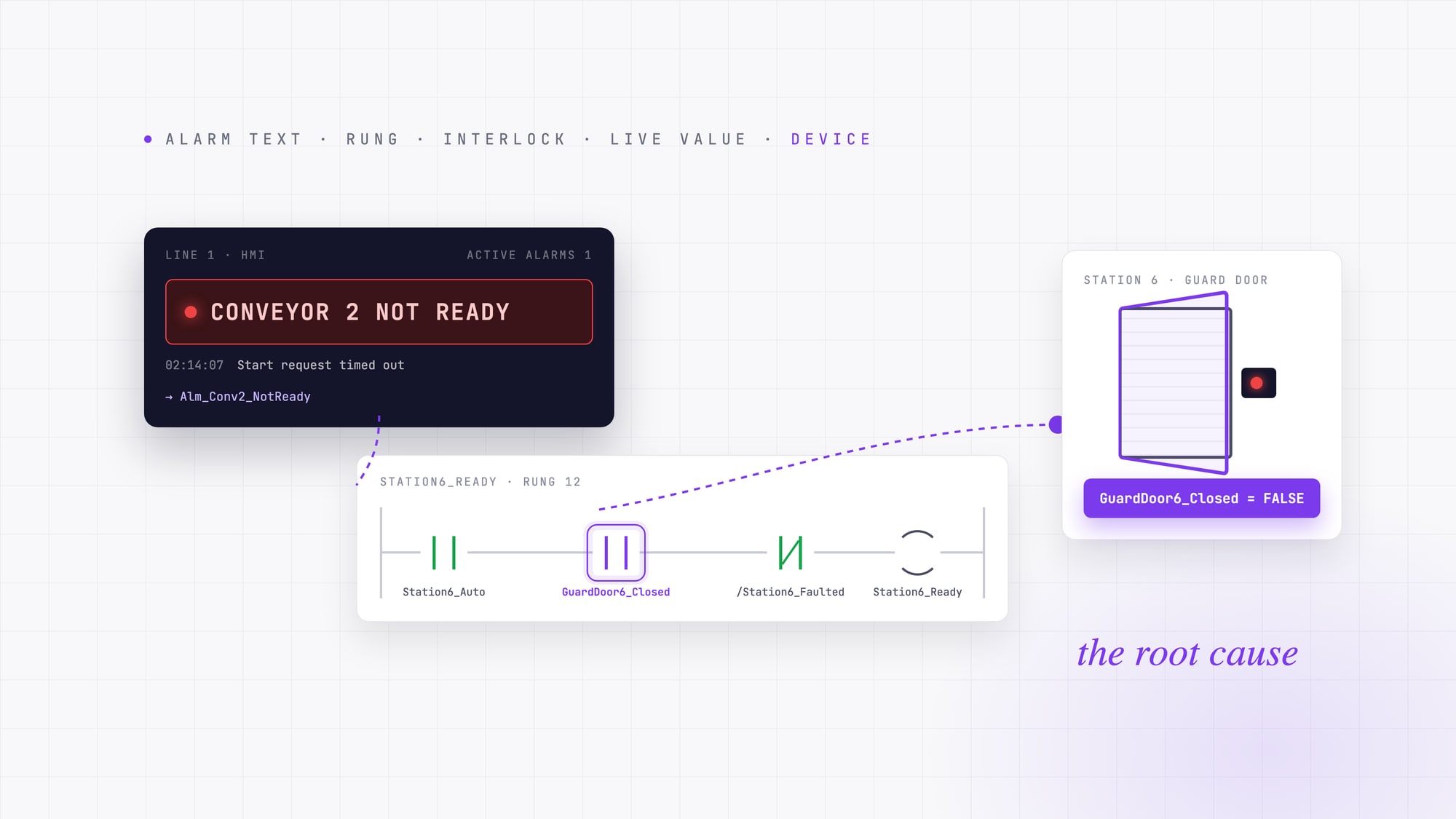
PLC fault codes and HMI alarms: how to trace an alarm back to its root cause
A PLC fault code or HMI alarm tells you where troubleshooting starts, not why the machine stopped. A field method for tracing an alarm from its text to the device behind it.
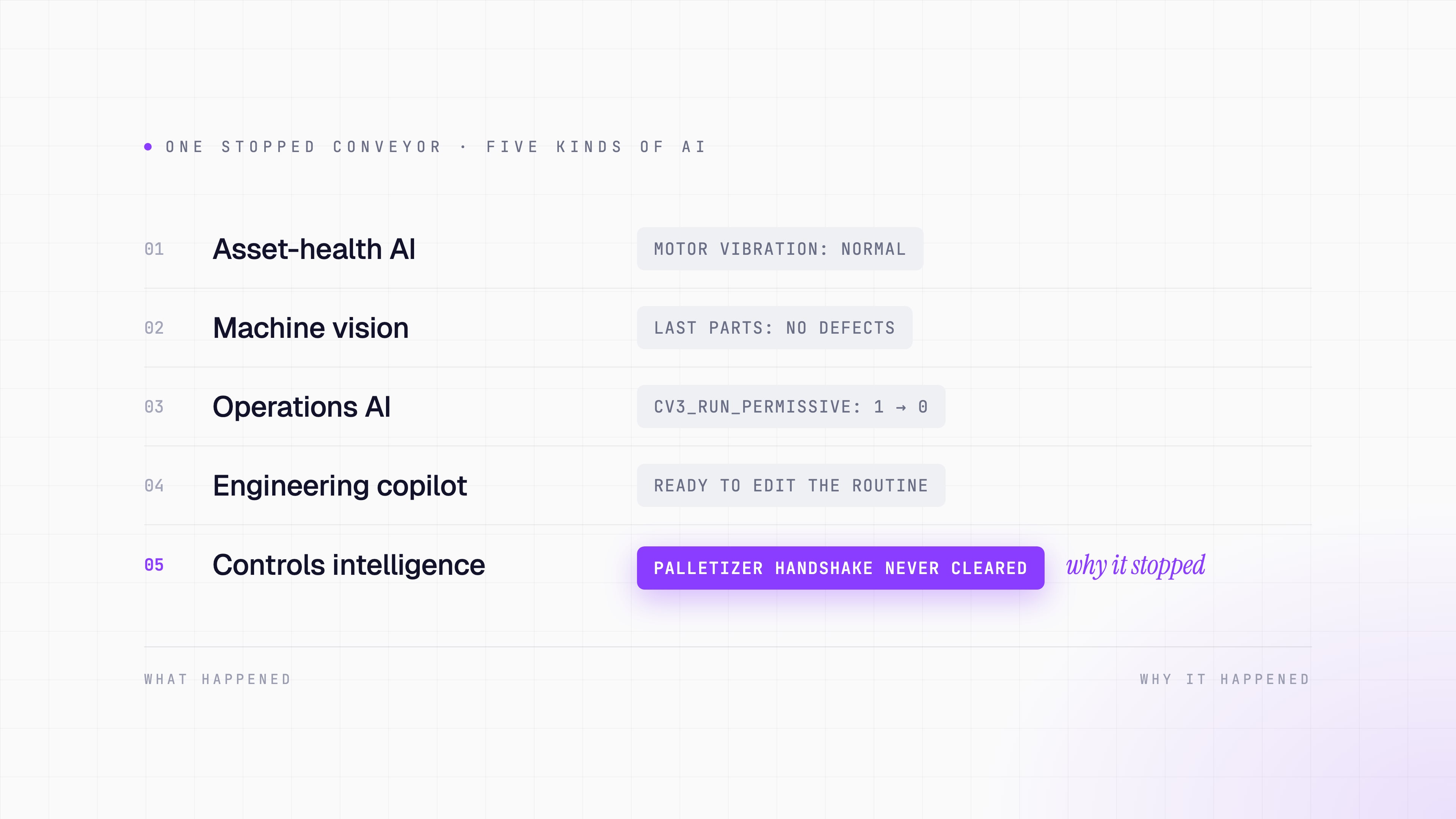
What is the best AI for industrial automation in 2026?
There is no single best AI for industrial automation. Compare industrial AI by the problem it solves, from machine vision to PLC troubleshooting.