
Why not just give an LLM more PLC context?
More context makes a general-purpose LLM more useful for a single PLC task. It doesn’t decide who curates that context, how conflicts between sources get resolved, how it stays current, or what happens when the AI gets it wrong. Here’s where that approach runs out.
You start experimenting with ChatGPT, Claude, Gemini, or another general-purpose LLM for PLC work.
You paste in a piece of ladder logic and ask what it does. You use it to review some Structured Text, explain a routine, or suggest a change.
It works.
In short: more context makes a general-purpose LLM more useful for a single PLC task. It doesn’t decide who curates that context, how conflicts between sources get resolved, how it stays current, or what happens when the AI gets it wrong. Those are different problems, and none of them go away by adding more files.
But pretty quickly, you reach a limit.
The LLM understands the code you gave it, but it doesn’t know what sits around that code. It doesn’t know the rest of the PLC project, the machine it controls, your naming conventions, the applicable standards, or what another PLC on the line may be doing.
So the natural next step is obvious: give the LLM more context.
Instead of a few rungs, give it the routine. Instead of the routine, give it the PLC project. Add tag descriptions, documentation, manuals, standards, engineering notes, and anything else that might help it understand the task.
And it does help. For an individual engineer working on a specific PLC task, providing more context to a general-purpose LLM can make it significantly more useful.
But how far can you take that approach? What happens as the amount of context grows? Who decides what should be included? What happens when two sources disagree, or the information changes, or the answer it returns is simply wrong?
At some point, the problem begins to shift. It is no longer only about giving an LLM more context. It is about creating, structuring, maintaining, prioritizing, and trusting the automation context the LLM depends on. And those are two very different things.
Can you give an LLM PLC code and ask questions about it?
Yes. Modern large language models can understand common PLC programming concepts and languages. An engineer can paste ladder logic or Structured Text into an LLM and ask it to explain the logic, identify potential problems, suggest code, or answer questions.
But by default, that understanding is generic. The LLM doesn’t inherently know the industry the code operates in, the machine or process it controls, the engineering standards being followed, or the organization’s own programming conventions, naming standards, libraries, and guidelines.
Give the model more information and it generally has more to reason with. Instead of a few rungs, provide a larger section of the program. Instead of one routine, provide the complete PLC project. Add tag descriptions, equipment documentation, industry standards, organizational guidelines, manuals, and engineering notes. The model now has more of the information an experienced automation engineer would use to understand the problem.
And this is where the context problem begins.
The quality of the answer increasingly depends not only on the model, but on whether the right automation context has been identified and provided to it.
Who creates the context for the LLM?
Imagine a machine stops unexpectedly. An experienced engineer knows which PLC controls it. They locate the latest PLC project, identify the relevant routines, find the equipment documentation, and provide that information to the LLM.
That can work. But consider a slightly more complicated problem. The PLC shows that the machine is waiting for an upstream permissive. That permissive originates in another PLC controlling another machine. There may also be a sequence description in a local document, an engineering change made six months ago, and a live signal currently preventing the sequence from advancing.
Which of those pieces should go to the LLM, and more importantly, who knows they’re all relevant in the first place? In many cases, the experienced engineer does. But that means the engineer isn’t simply providing context, they’re creating it, and that only works as long as the engineer already knows what to look for. It gets much harder when AI is expected to help someone who doesn’t.
Are more files the same as automation context?
No. Suppose an LLM is given two PLC projects, an equipment manual, an electrical drawing, a sequence document, an industry standard, and engineering notes. It now has substantially more information. But automation context is not simply a collection of files. The important information is often the relationships between them.
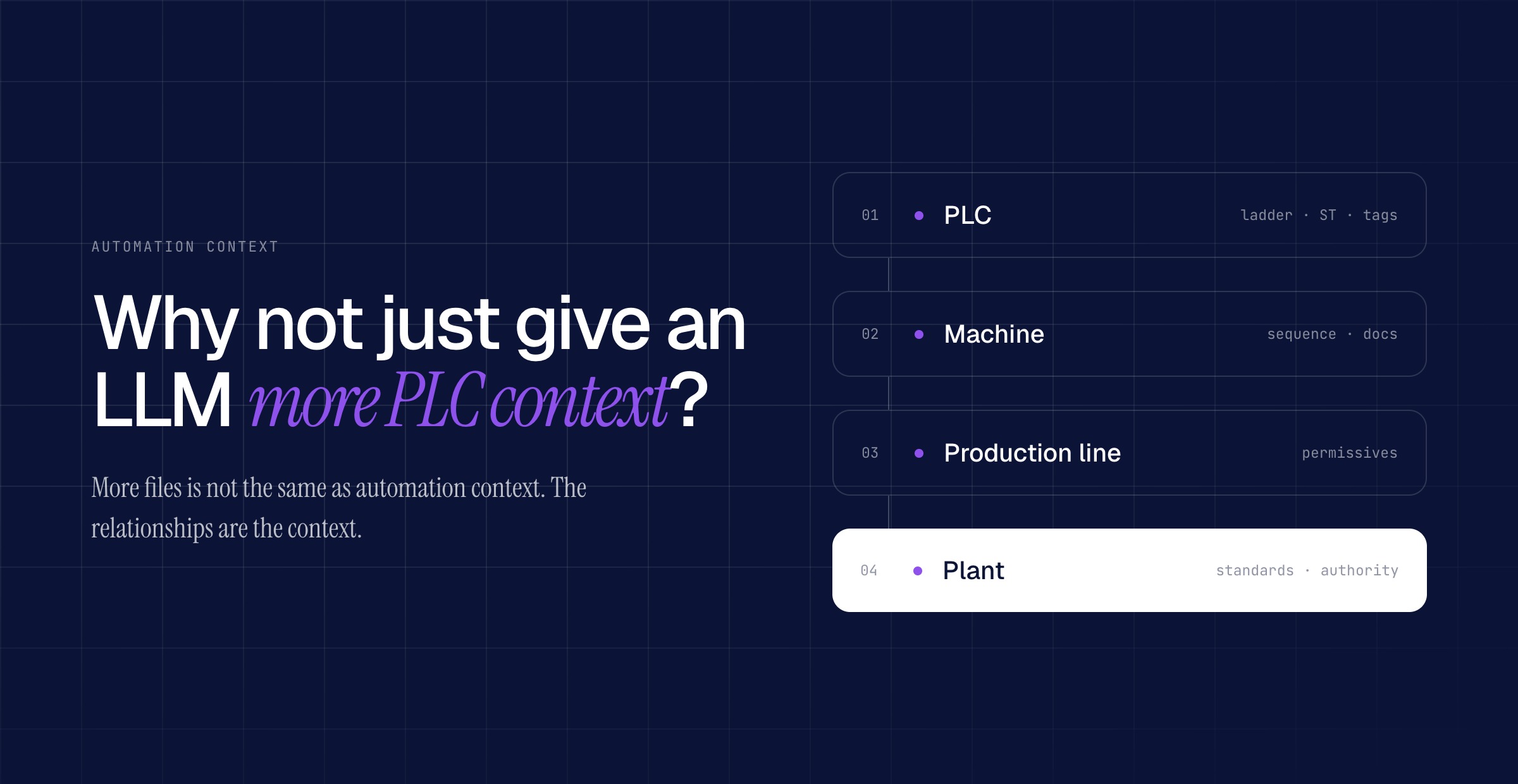
One PLC controls the filler. Another controls the capper. A tag in the first PLC represents a handshake from the second. A sequence document explains the expected interaction. An engineering change modified that behavior. The production-line structure explains why these assets belong together.
PLC → Machine → Production Line → Plant
So do the dependencies between assets. A machine controlled by an Allen-Bradley PLC may depend on another Allen-Bradley PLC, or on a Siemens PLC somewhere else on the production line.
Providing all those projects gives an LLM more information. Understanding how they relate as part of the same automation system gives that information meaning.
What happens when the context becomes large and unstructured?
Giving an LLM more context helps, but only up to a point. Modern LLMs can process large amounts of information, but simply uploading more of it doesn’t guarantee the model will correctly identify what matters, understand how everything relates, or know which information should take priority.
An industrial context might contain multiple PLC projects, different versions of the same project, manuals, engineering standards, local programming guidelines, electrical drawings, engineering notes, machine documentation, and information from different automation vendors. At some point, the challenge is no longer simply context size. It becomes:
- 01Context quality.
- 02Context structure.
- 03Context relevance.
- 04Context hierarchy.
- 05Context control.
And hierarchy is particularly important.
When information conflicts, what should the AI trust?
Industrial automation context is rarely a perfectly clean collection of facts. Sources can conflict. An older PLC project may differ from the version currently deployed. A document may describe behavior that has since been changed in the code. An industry standard may recommend one approach while the organization has intentionally adopted an approved local practice. An engineer’s note may contradict formal documentation.
Simply placing all of this into an LLM’s context window doesn’t answer a critical question: what should prevail? Which PLC project is authoritative? Does the latest deployed code take precedence over an older document? Which source should the AI trust when two pieces of information disagree?
More context without hierarchy can actually introduce more ambiguity. A useful automation context therefore needs more than information. It needs an understanding of authority, relationships, versions, relevance, and precedence.
What happens when the LLM is wrong?
There’s another issue that becomes increasingly important as AI moves closer to the production environment: an LLM can produce an answer that sounds convincing and is still incomplete or incorrect. It can overlook a dependency, give too much weight to outdated information, infer something the PLC logic doesn’t actually support, or hallucinate outright.
For an experienced controls engineer, that may be manageable. They may immediately recognize that an answer doesn’t make sense and investigate further. But what happens when AI is being used by a maintenance technician, operator, or less experienced engineer? As AI becomes accessible to more people, relying on the user to catch every questionable conclusion becomes increasingly problematic.
The system itself needs controls: how is an answer validated against the actual PLC logic and the authoritative project version? How are organizational standards considered? How is confidence communicated, and how are unsupported conclusions identified before someone acts on them?
The requirement therefore moves beyond simply providing context. It becomes about providing trusted and governed context, with controls around how the AI reasons over it.
What happens when the automation context changes?
There’s also a practical problem with manually providing context to an LLM: automation context does not stand still. PLC programs change. New versions are deployed. Machines are modified. Documentation is updated. Engineering decisions accumulate. Production lines evolve.
If context is assembled manually for each AI interaction, someone needs to repeatedly determine which information is current and relevant. The larger the environment becomes, the harder this becomes.
Giving an LLM more context works, until managing the context becomes part of the problem.
At that point, persistent context, repository synchronization, document synchronization, version history, and structured relationships between automation assets begin to matter. The problem is no longer whether the LLM has a large enough context window. It’s whether it receives the right automation context, in the right structure, at the right time.
What about live PLC data?
PLC projects describe how an automation system is designed to behave. But troubleshooting often depends on understanding how it is behaving right now. The logic might show that a conveyor starts when five permissives are true. The project explains those conditions. Live PLC values reveal that four are true and one is false.
PLC logic tells AI what should happen. Runtime data helps explain what is happening now.
Once live state becomes part of the context, it’s no longer simply a collection of files that can be uploaded into a conversation. The context becomes dynamic.
Does the context survive the conversation?
There’s also a longer-term question. An engineer might spend an hour working with an LLM and discover something valuable about a machine: a confusing tag finally explained, a dependency between two PLCs identified, an undocumented behavior made clear, a recurring failure mode understood.
What happens to that knowledge? If it stays inside one engineer’s conversation, the next engineer may have to rediscover it. For a manufacturer, valuable automation knowledge needs to become persistent organizational knowledge, rather than context repeatedly assembled for individual AI interactions.
When is a general-purpose LLM enough for PLC work?
Quite often, particularly when getting started. A general-purpose LLM can be useful when the objective is to experiment with AI, understand a piece of ladder logic or Structured Text, ask questions about supplied code, generate or review isolated logic, or improve an individual engineer’s productivity. The entry barrier is extremely low, which makes this a natural first step for many manufacturers.
The requirements begin to change when the objective expands beyond one engineer, one PLC, one task.
When does the requirement become something more?
As AI adoption expands, so does the context it needs to understand:
Code snippet → Complete PLC project
One PLC → Multiple PLCs
One vendor → Mixed-vendor automation
Static logic → Live automation state
At that point, continually giving an LLM more information isn’t necessarily the scalable solution. The automation context itself starts becoming infrastructure. The LLM remains important, and different LLMs may ultimately consume that same context, but the model shouldn’t have to independently reconstruct the automation environment every time someone asks a question.
So, why not just give an LLM more PLC context?
You can. For individual PLC tasks and early AI experimentation, it’s a fast and valuable way to start.
But there’s an important difference between giving an LLM context for a task and building automation context for an organization: the logic, the equipment, the sequences and dependencies, and the engineering history that make a production system what it is, kept structured, current, and trustworthy enough for AI to reason over.
More context alone doesn’t guarantee any of that. It doesn’t decide what’s current, resolve what’s relevant, or catch the AI when it’s wrong.
As the requirement expands from code to projects, from one PLC to a production line, and from one engineer to a broader team, context stops being something you paste into a conversation. It becomes automation context: infrastructure the organization has to build, not a prompt it has to write.
Giving an LLM more context works, until managing and trusting that context becomes part of the problem.
What automation context actually means, and why it has to be the anchor →The manufacturing AI adoption journey: from individual tools to enterprise intelligence →More from the blog
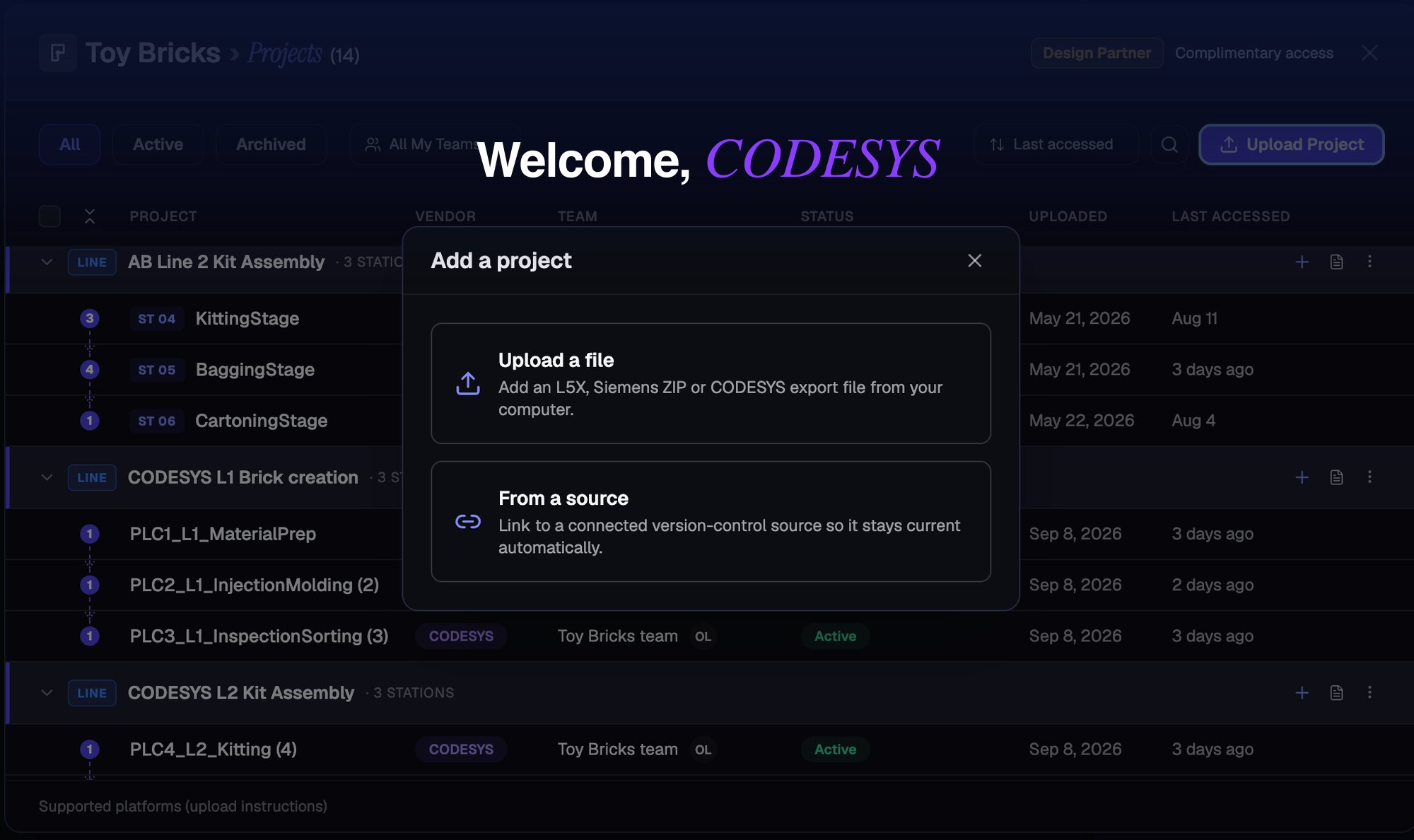
PLCs.ai now supports CODESYS V3 projects, across the entire CODESYS ecosystem.
PLCs.ai now supports CODESYS V3 projects, across first-party CODESYS environments and OEM platforms like WAGO, ABB, and Bosch Rexroth. A CODESYS export has no tag table and no hardware/IO tree, so getting there took real re-engineering, not just a new parser.
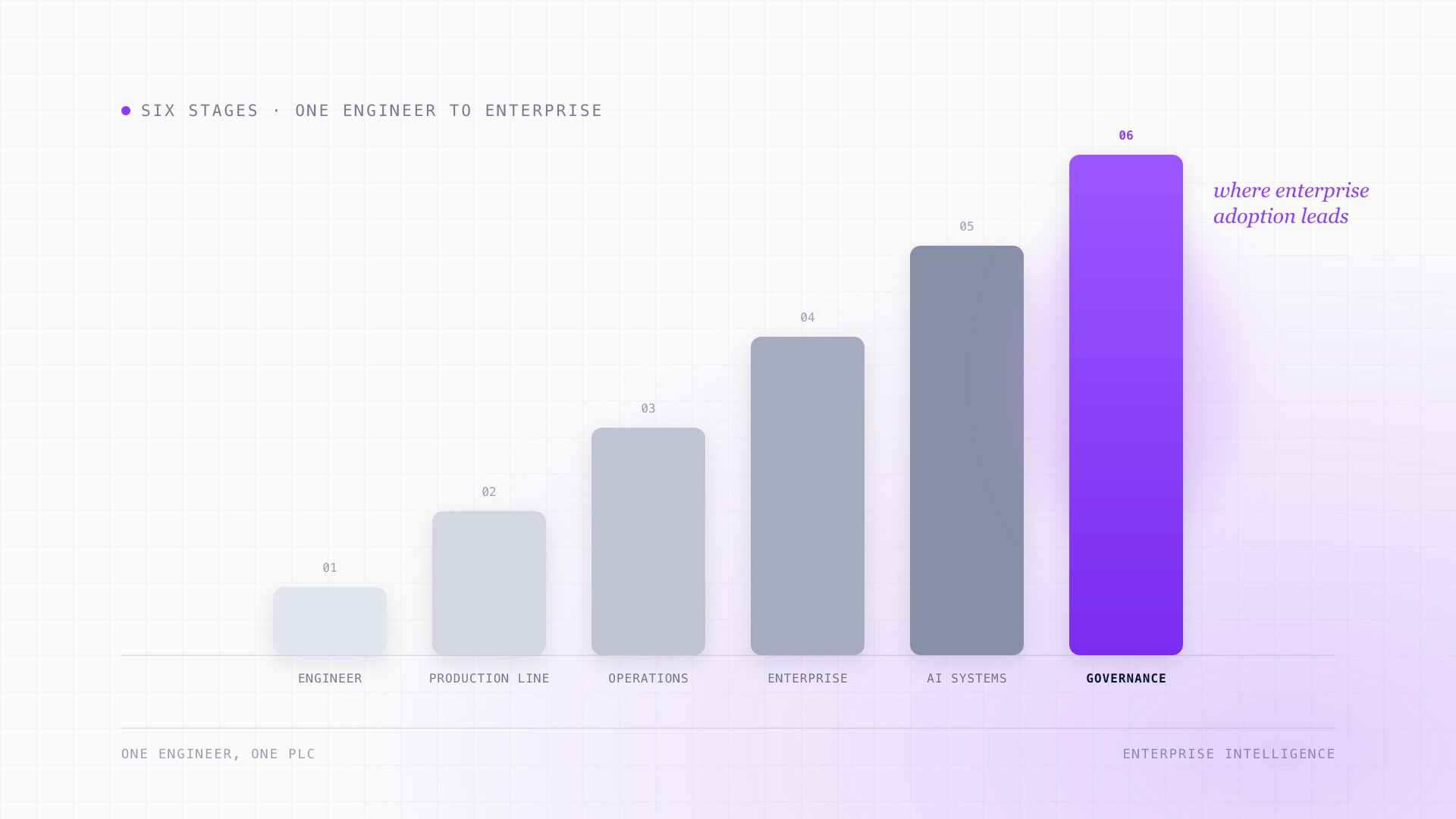
The manufacturing AI adoption journey: from individual tools to enterprise intelligence.
AI adoption in manufacturing almost never starts as a transformation. It starts with one engineer, one PLC, and one AI model. What changes at each stage after that, from helping a maintenance tech at 2 AM to governing access across an entire enterprise, and why the infrastructure needed at the end looks nothing like where most manufacturers start.
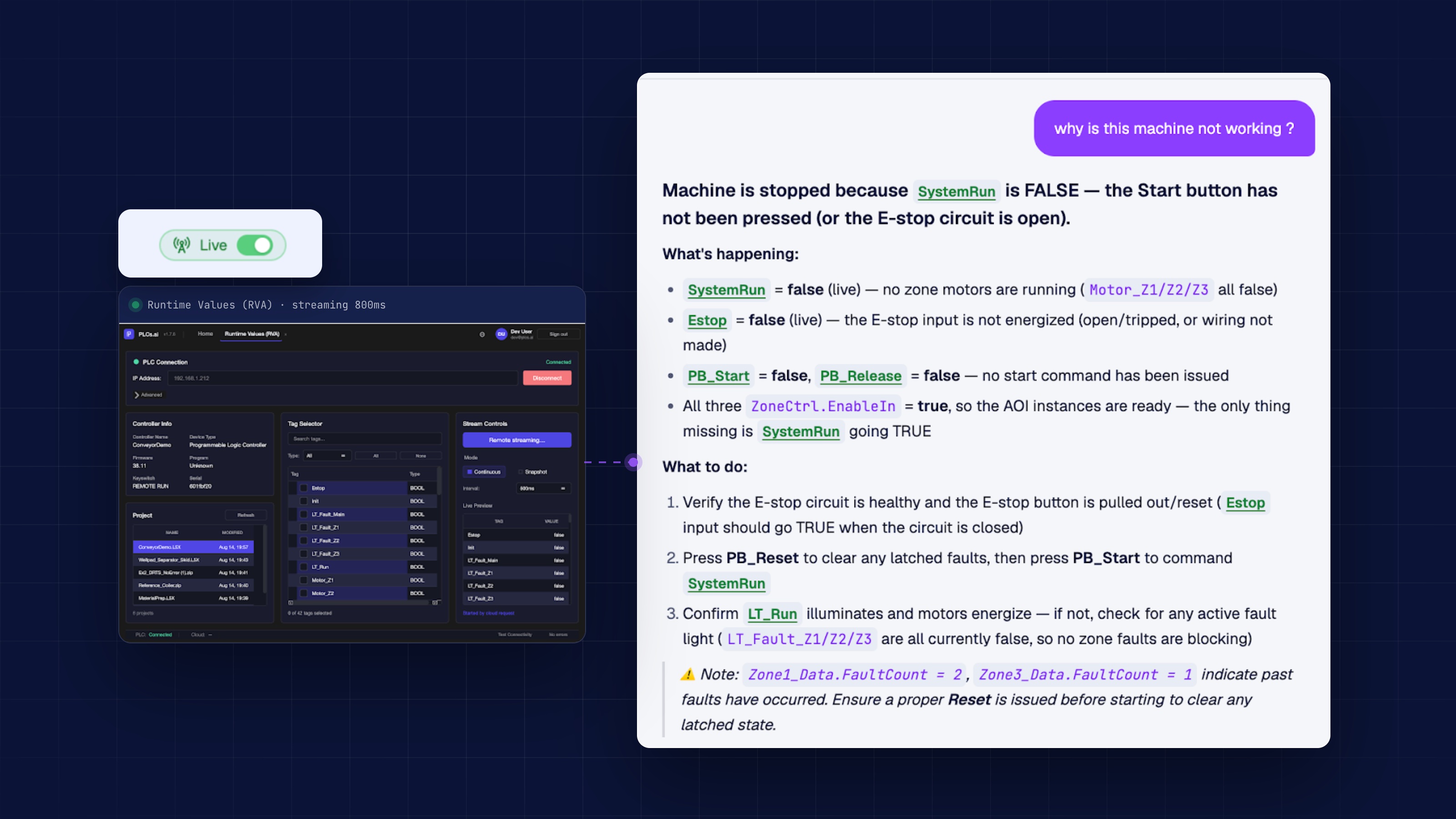
Runtime PLC data doesn’t just help troubleshooting. It multiplies it.
Reading the code tells you what a line is supposed to do. Runtime tag values tell you what it is actually doing right now. Troubleshooting needs both, and the gap between them is where most outages drag on.