
Is Siemens Industrial Copilot worth it?
Siemens Industrial Copilot can be worth it when the goal is faster Siemens engineering. If the goal is troubleshooting production, understanding the whole line or giving maintenance teams answers, an engineering copilot alone may not be enough. How to tell which one you need.
Short answer: Siemens Industrial Copilot can be worth the investment when your goal is to make Siemens engineering work faster. But if your priority is understanding existing automation systems, troubleshooting production problems, or making PLC knowledge accessible to maintenance teams, an engineering copilot alone may not be enough.
The important question is not simply which PLC brands are installed in your plant. It is what you expect AI to do.
Writing a new function block faster and understanding why a production line stopped at 2:40 a.m. are different jobs. Both matter, but they demand different kinds of context, workflows and access. Here is how to evaluate Siemens’ offerings, where they deliver value, and when to consider complementary approaches.
First, which Siemens copilot are we talking about?
“Siemens Industrial Copilot” is the umbrella name most buyers search for. For PLC engineering in TIA Portal, the product behind that name has changed, so it helps to know which one you are evaluating.
| Offering | What it is | What to check in a pilot |
|---|---|---|
| Engineering Copilot TIA Essential | Siemens’ first generative AI assistant for TIA Portal, on the Siemens Xcelerator marketplace since July 2024. Chat-based help with code generation and engineering questions. | Whether it is still offered to you, and on which terms |
| Eigen Engineering Agent | Siemens’ current AI agent for TIA Portal. Generates and adapts SCL and LAD code, generates test logic, fixes compile errors, and helps with HMI, drive and documentation tasks. | Supported TIA Portal versions, which tasks it completes on your own projects, review controls, subscription cost |
Siemens’ product pages for Engineering Copilot TIA now open the Eigen Engineering Agent page, so for most buyers today, Eigen is the product to evaluate. That matters for one common claim: “Siemens AI only writes SCL” is out of date. Siemens says Eigen supports both SCL and LAD generation.
Eigen is sold as a subscription through the Siemens Digital Exchange marketplace, with a one-month free trial. Siemens does not publish prices, so pricing comes from its sales team. Start with the Eigen Engineering Agent product page and its prerequisites and licensing documentation. Features change from release to release, so compare the version you can actually deploy, not an older feature list.
Where Siemens Industrial Copilot delivers real value
For the right engineering team, there is a strong case for an AI assistant built into the development environment it already uses.
- 01Faster routine engineering. Generating standard logic, preparing function blocks and handling recurring programming tasks can cut the time spent on routine authoring. The benefit is largest when the output fits the team’s conventions and can be reviewed quickly.
- 02Understanding unfamiliar code. Explaining a block or sequence helps an engineer understand a project they did not write. This is particularly valuable where documentation is incomplete or knowledge sits with a few experienced people.
- 03Less switching between tools. Finding the right technical information inside the engineering workflow saves time that engineers would otherwise spend moving between TIA Portal, manuals and search.
- 04Testing and multi-step tasks. Eigen goes beyond answering questions. Siemens says it generates test logic, fixes compile errors and can build a project structure from a plain-language description of the machine. Check which of these work on your own projects.
None of these benefits requires a Siemens-only factory. A manufacturer with Siemens and Allen-Bradley equipment may still see a strong return from Siemens AI for its Siemens engineering team. The value depends on how much of the team’s time goes to supported tasks, how reliably the output can be reviewed, and how easily the tool fits into existing engineering practice.
Where an engineering copilot may not be enough
The distinction is not that one product is good and another is bad. Engineering productivity and plant-level understanding are different problems. An engineering copilot is centered on one engineering project and the engineer working in it. Production troubleshooting needs a wider view, and that wider view is what PLCs.ai is built for.
| What production troubleshooting needs | What PLCs.ai does |
|---|---|
| Multiple controllers. A fault may begin in one PLC and show up as a symptom in another, often from a different vendor. | Reads every PLC project on the line (Studio 5000, TIA Portal and CODESYS V3) and traces signals from one controller into the next. |
| Relationships between machines. Interlocks, handshakes and upstream or downstream permissives matter as much as the logic in any single block. | Maps the handshakes and permissives between machines, so a “not ready” on one machine can be followed to its source on another. |
| Current operating state. Project files describe intended behavior. Why something is happening now depends on live values. | The Companion App streams live tag values from Allen-Bradley, Siemens and CODESYS V3 controllers, read-only, so answers reflect what the machine is doing right now. |
| Access beyond the controls team. Technicians and operators need answers without an engineering IDE or license. | Anyone on the team asks in plain language from a browser. No IDE, no engineering workstation, no seat license. |
| Trust and governance. Answers must be grounded in the right project version, the plant’s standards and evidence someone can check. | Every query runs against your own project, approved standards and specs, and every insight is versioned so it survives staff turnover. |
These are evaluation criteria, not permanent claims about what Siemens can never offer. Siemens’ products will evolve. Test whether the offering available today can answer the questions your teams actually face. We have written more about why maintenance teams need answers outside the IDE.
A worked example: the filler that will not start
This is an illustrative scenario, not a customer case study.
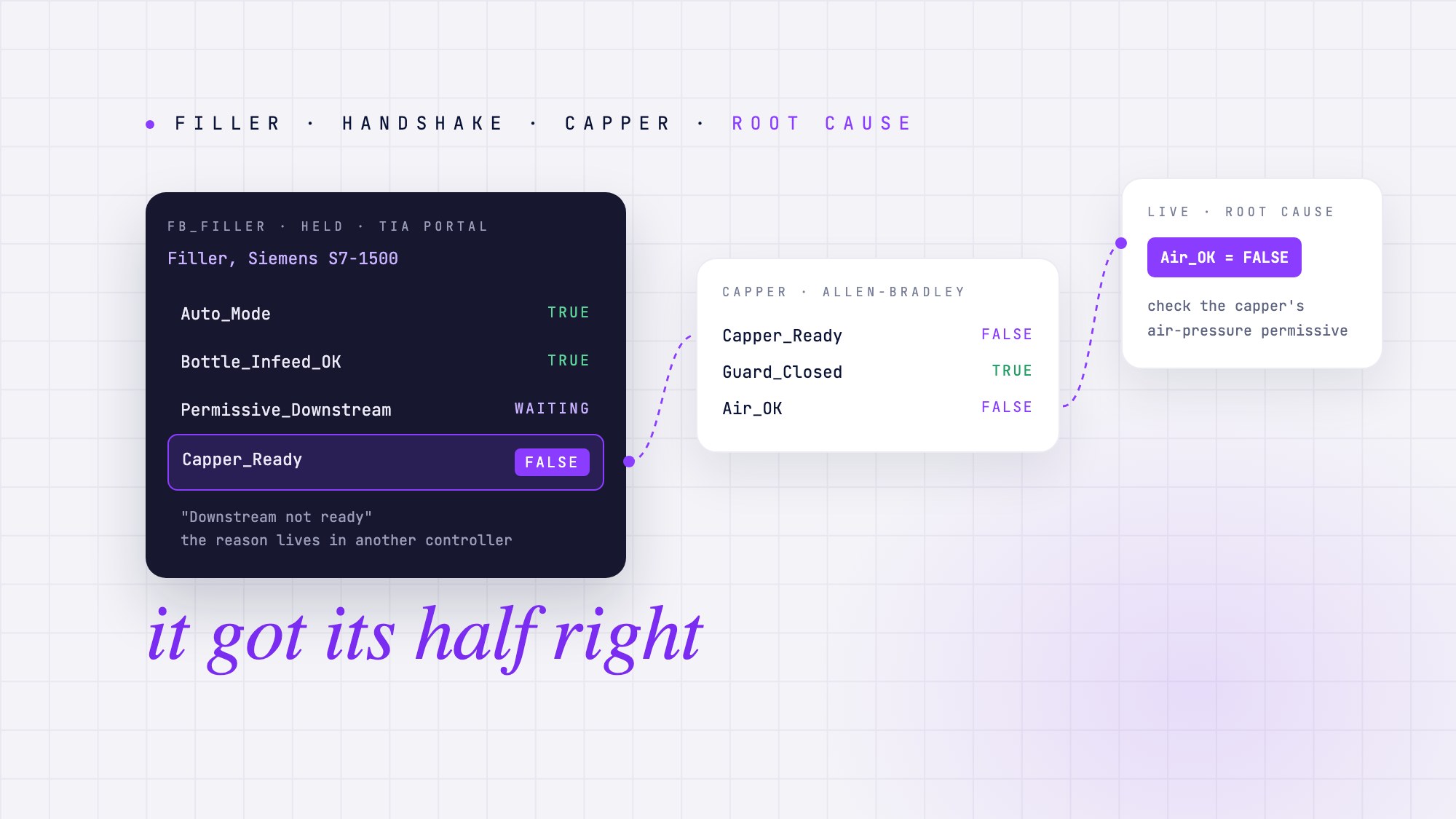
A bottling line has a Siemens S7-1500 controlling the filler and an Allen-Bradley ControlLogix controlling the downstream capper. At 2:40 a.m., the filler goes into a held state. Its HMI reports “Downstream not ready.”
The filler logic shows that DB_LineHandshake.Capper_Ready is false, so FB_Filler.Permissive_Downstream is not satisfied. The Siemens project explains why the filler is waiting, but the ready signal comes from the capper’s controller through the line’s data exchange.
With an engineering copilot: a controls engineer opens the Siemens project and asks about the held state. The copilot helps explain the Siemens-side permissive and sequence. To find out why the capper is not ready, the engineer still has to open the Allen-Bradley project, follow the cross-controller mapping and check the live equipment state with other tools.
With a plant-level intelligence layer: both controller projects have been loaded, their signal relationships are mapped, and read-only live values are available. A technician asks why the filler is held. The system traces the ready signal into the capper logic and finds that Capper_Ready depends on Capper.Guard_Closed and Capper.Air_OK. The live value of Capper.Air_OK is false, so it directs the technician to the capper’s air-pressure permissive, subject to normal on-site verification and safety procedures.
The second workflow is not magic. It needs reliable project context, a correct signal mapping, the right runtime connection and an answer that shows its evidence.
The point is not that Copilot got it wrong. It got its half right. The fault lived in the other half.
How to evaluate the ROI of industrial AI
Before signing a subscription, define the work you want the product to improve. Do not treat headline productivity claims as if they automatically turn into plant-wide savings.
| Question | What to measure in a pilot |
|---|---|
| What problem are we solving? | Engineering time saved, troubleshooting time reduced, or both |
| Who needs access? | Number and roles of actual users, including engineers and maintenance technicians |
| What context does the task need? | A single project, cross-controller dependencies, documentation, standards or live values |
| How much of the work is supported? | Share of real tasks completed successfully, not the quality of a polished demo |
| How much validation remains? | Review, testing, commissioning and safety checks after AI assistance |
| What is the full cost? | Licenses, deployment, integrations, training, security review and ongoing administration |
For an engineering team, a useful pilot compares the time to implement and review several representative changes, with and without AI. For maintenance, measure the time to identify the cause of a recurring stoppage, how often the answer is correct, and whether technicians can act on it safely.
A four-week pilot on real but controlled tasks tells you more than an assumed percentage improvement. Keep every production change inside your existing engineering approval and validation process.
What are the alternatives to Siemens Industrial Copilot?
“Alternative” can mean a competing way to speed up engineering work, or a complementary tool for a different operational problem. Those should not be confused.
| Approach | Primary value | Typical limitation or consideration |
|---|---|---|
| OEM-native engineering copilots | Assistance built into the vendor’s development environment | Scope and access follow the vendor’s supported tools and releases |
| General-purpose AI connected to engineering tools | Flexible model choice and custom engineering workflows | Needs careful context management, permissions, validation and integration |
| Plant-level automation intelligence | Understanding existing systems across projects, machines and live operating state | Needs accurate project ingestion, relationship mapping and a suitable runtime connection |
PLCs.ai sits in the third row. Its Runtime Value Stream feature, delivered through the Companion App (aka Companion), checks the logic against live tag values over a read-only, outbound-only connection to a SOC 2 Type II audited platform. Live coverage keeps expanding.
That does not make Siemens’ AI and PLCs.ai mutually exclusive. A machine builder might use Eigen to speed up authoring in TIA Portal, while the same manufacturer’s maintenance team uses a plant-level tool to understand how the finished machines interact once they are running.
The relevant question is whether you need an assistant for creating automation logic, a shared understanding of the automation already running, or both. For a direct comparison, read PLCs.ai vs. Siemens Industrial Copilot. For the wider context problem, see why industrial AI must understand the entire production line.
So, is Siemens Industrial Copilot worth it?
Yes, potentially, if your main goal is faster Siemens engineering and the supported workflows match how your team actually works. The case is strongest when engineers repeatedly perform tasks the product can speed up, and can validate its output without adding more work than they save.
It may not be enough on its own if your goal is faster production troubleshooting, cross-controller understanding or broad access to automation knowledge. Those goals call for a different evaluation of context, runtime data, integration and user access.
Do not begin with the brand of the AI tool. Begin with the problem you need it to solve.
Frequently asked questions
Is Siemens Industrial Copilot worth it for a small machine builder?
It can be, especially if the builder repeats supported Siemens engineering tasks across many projects. Use the one-month Eigen trial to test representative tasks, including review and validation time, before deciding whether the subscription and deployment costs are justified.
How much does Siemens Industrial Copilot cost?
Siemens does not publish prices. Eigen Engineering Agent is sold as a subscription through the Siemens Digital Exchange marketplace, with a one-month free trial, and pricing comes from Siemens’ sales team.
What are the advantages of Siemens Industrial Copilot?
Its main advantage is bringing AI assistance into Siemens engineering workflows. Depending on the offering and release, that includes code generation and explanation, technical information retrieval, test logic generation and multi-step project tasks.
Does Siemens Industrial Copilot support ladder logic?
In its current form, yes. Siemens says Eigen Engineering Agent, its current AI agent for TIA Portal, supports both LAD and SCL generation. The earlier Engineering Copilot TIA was mainly described around SCL. Check the supported languages in the release you are evaluating.
What are the alternatives to Siemens Industrial Copilot?
Options include other vendor-native engineering copilots, general-purpose AI connected to engineering tools, and plant-level intelligence platforms such as PLCs.ai. The first two mainly address engineering workflows. The third addresses understanding and troubleshooting existing automation across a broader operating context.
Can maintenance technicians use Siemens Industrial Copilot?
That depends on the product’s access model, licensing and how the plant provisions engineering tools. Rather than assuming every technician needs an engineering seat, test whether the intended users can get the information they need in their normal workflow.
Is Siemens Industrial Copilot the same as Eigen Engineering Agent?
Not exactly. Siemens Industrial Copilot is the umbrella name for Siemens’ generative AI assistants. For TIA Portal engineering, the first product was Engineering Copilot TIA, and Siemens’ pages for it now lead to Eigen Engineering Agent, its current AI agent for TIA Portal. If you are buying AI for TIA Portal engineering today, Eigen is the product to evaluate.
See what PLCs.ai does with a TIA Portal project →Try it on your own project, start a free trial →More from the blog
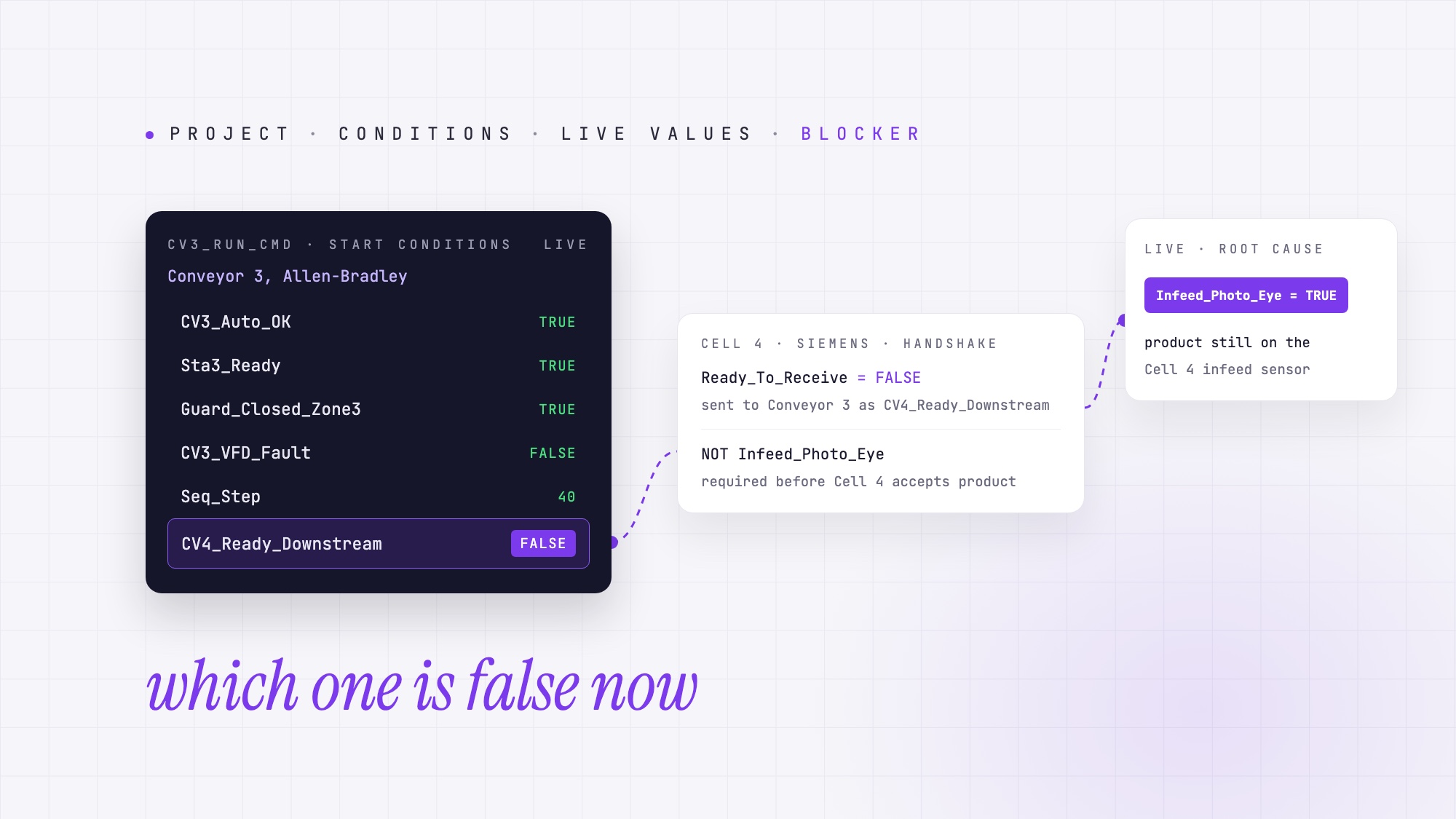
Can AI confirm a PLC fault against live tag values?
The project file tells you which conditions gate an output. The live values tell you which one is false right now. How AI combines the two to confirm a PLC fault.
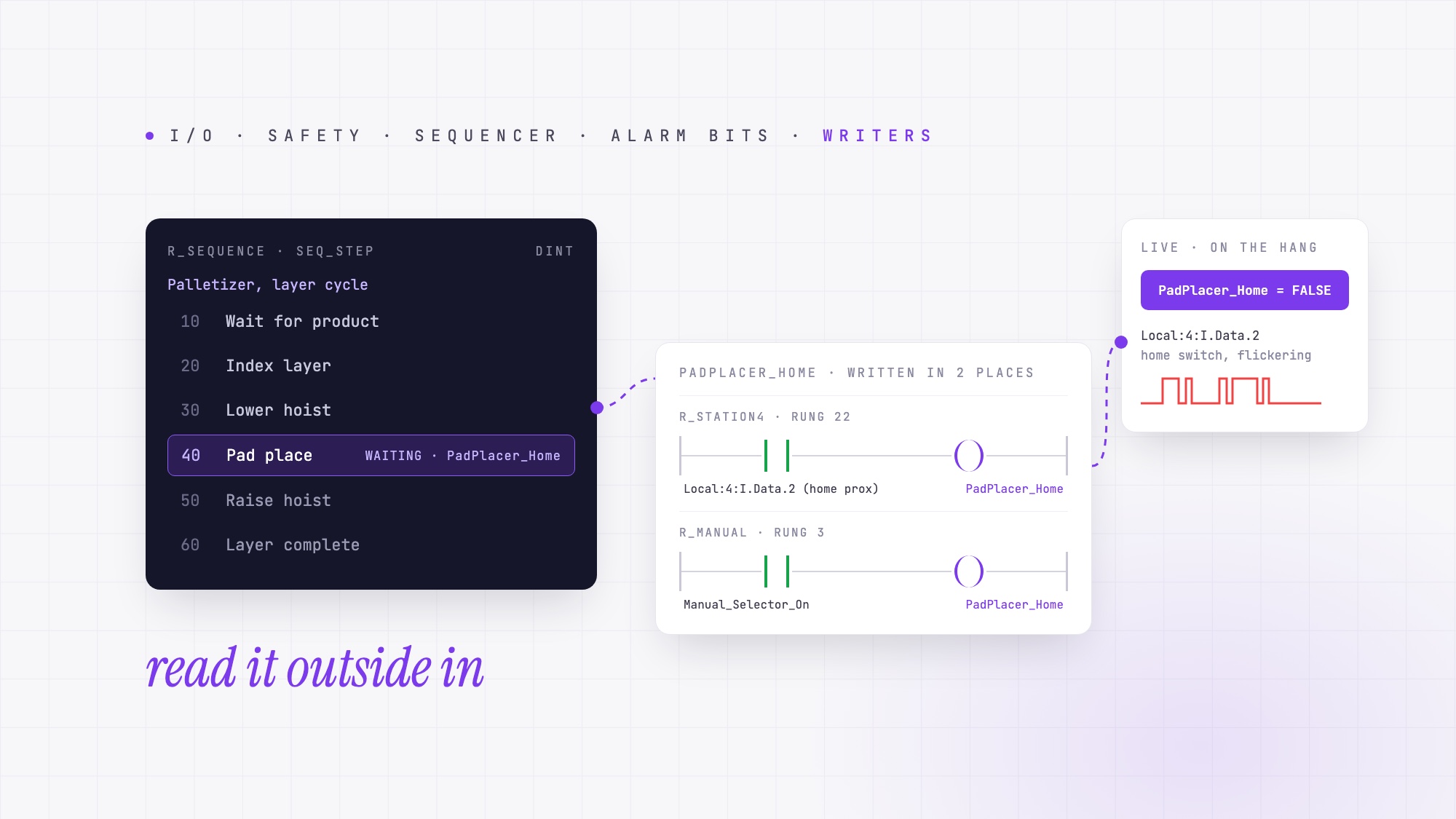
How do I understand an undocumented PLC program I inherited?
The engineer who wrote it is gone, the comments were never written, and the machine still has to run. A working order for inherited PLC programs, and what AI can trace for you.
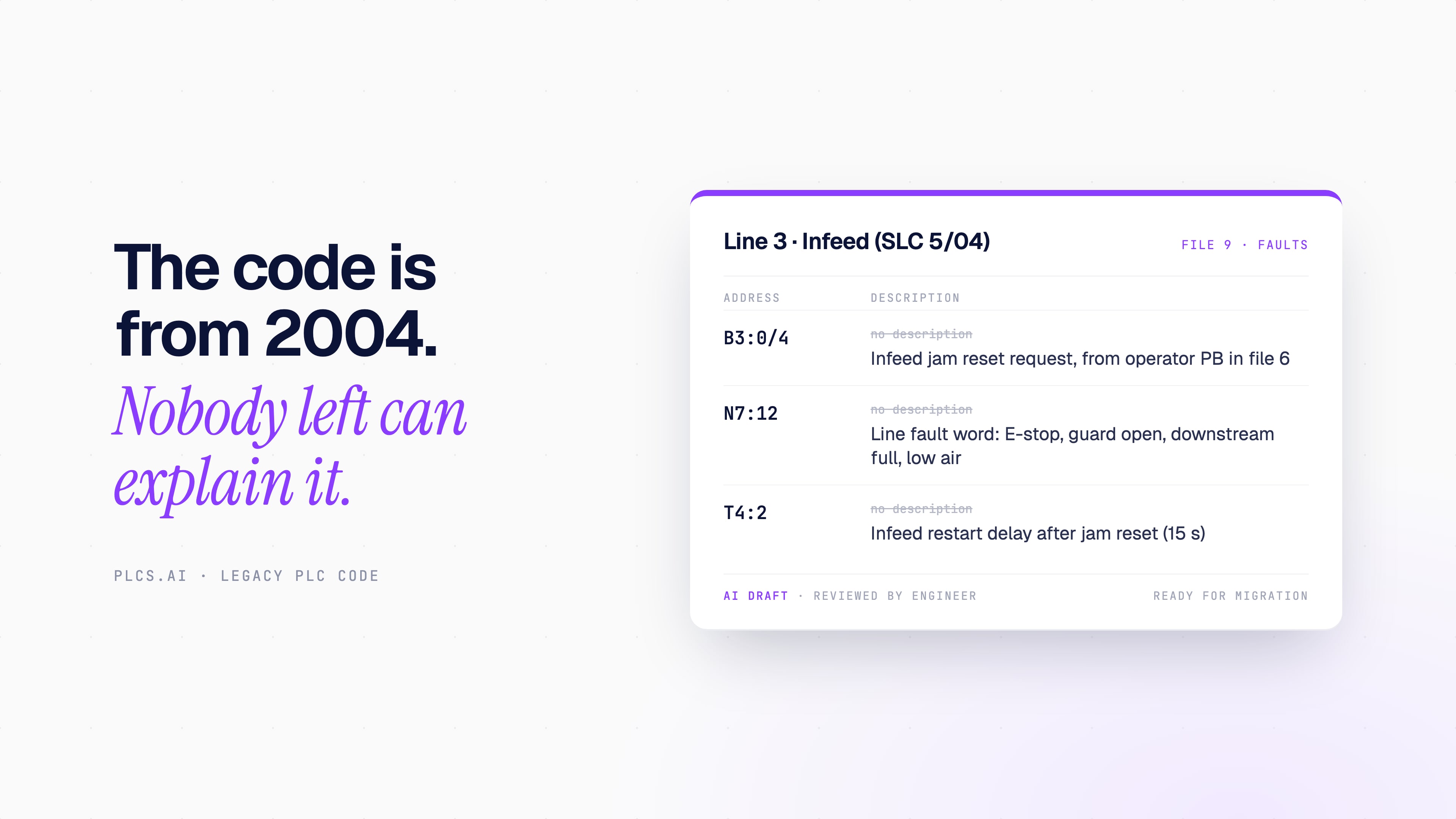
AI for legacy PLC code: understand, document and migrate programs nobody wants to touch
Can AI understand, comment or convert old PLC programs? What it does well on RSLogix 500, PLC-5 and S7-300 code, what the vendor tools still do, and what still needs an engineer.