
Six things every PLC engineer runs into, and how PLCs.ai finds them automatically.
Cycle-time bottlenecks, dead code, missing interlocks, broken handshakes, race conditions, and signal tracing. Plain-English explanations of concepts that usually take years on the floor to learn to spot.
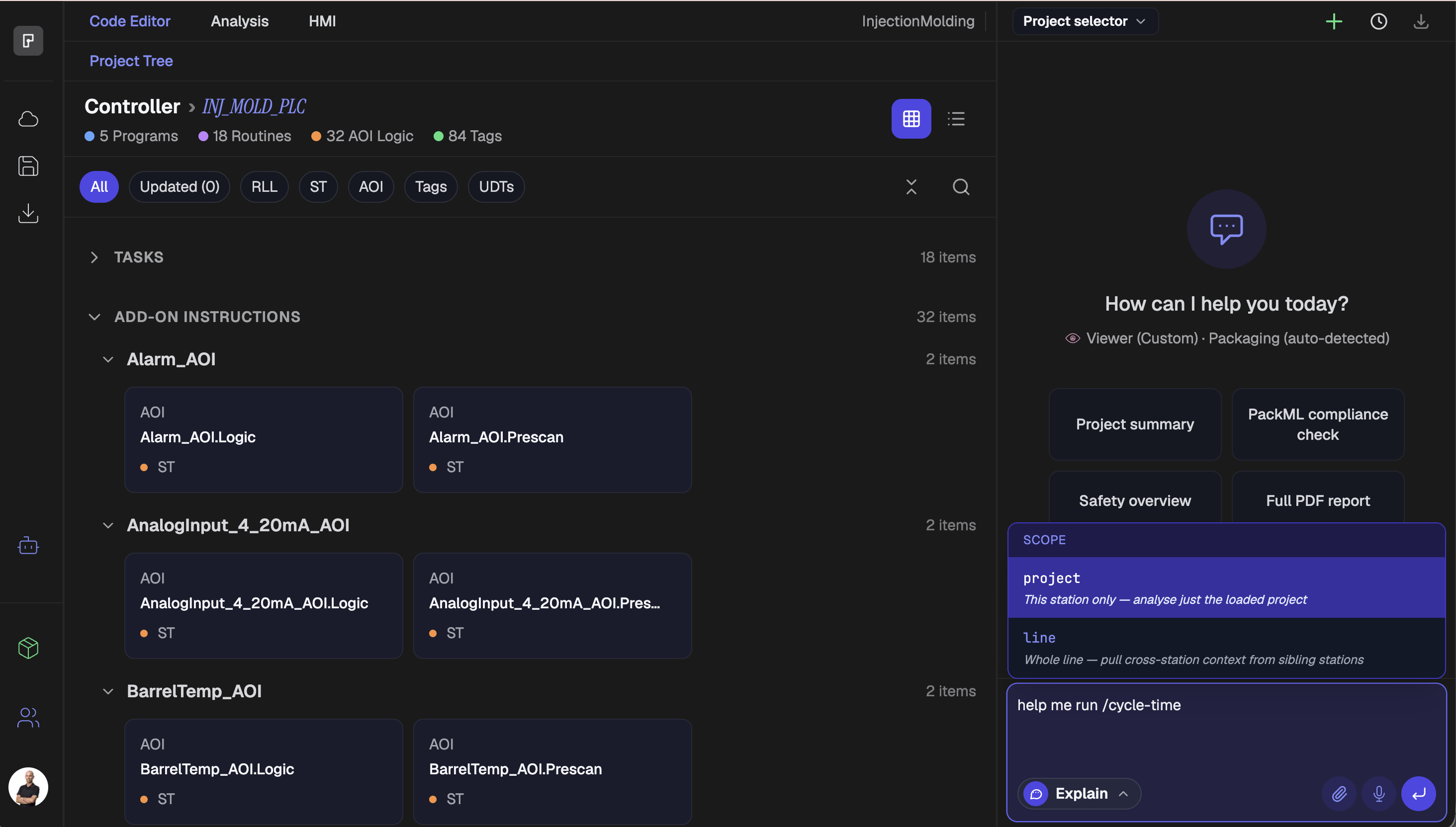
Every PLC engineer runs into the same six things eventually. Cycle-time bottlenecks, dead code, missing interlocks, broken handshakes, race conditions, and signal tracing rarely show up in training. Most people learn to spot them on a live line, usually at the worst possible time.
Six things every PLC engineer runs into
- 01Cycle-time bottleneck. A step in a sequence that takes longer than it should, delaying the whole cycle. Often hides in timers or wait loops nobody has revisited since commissioning.
- 02Dead code. Logic that is disabled, bypassed, or unreachable. It adds risk every time someone modifies the program without knowing it is inert.
- 03Interlock audit. Safety interlocks like E-stops and guard doors are supposed to have a reset path, a bypass timeout, and confirmed feedback. An audit checks each chain for the gaps that do not show up until something goes wrong.
- 04Missing handshake. Two stations are supposed to confirm to each other before the next step proceeds. A missing handshake means one station can act on stale information from the other.
- 05Race condition. When two parts of a program can write to the same tag, whichever runs last wins, and that order is not always guaranteed. Some of the hardest bugs to reproduce.
- 06Signal trace. Following one tag through every place it is written and read across a project, useful before you touch something you do not fully understand yet.
This takes years to earn
None of these six things are simple to spot. Reading PLC code well, especially code someone else wrote, takes years. It means understanding not just the logic but the physical process behind it: what the machine is actually doing, how every sensor, actuator, and interlock is wired together, and what has to happen for the line to run without a hiccup.
This is not about knowing karate. It is about being a master of it.
Why we wrote this down
That mastery is exactly what these six skills package up. Type / in any PLCs.ai chat and pick /cycle-time, /dead-code, /interlocks, /missing-handshake, /race, or /signal-trace, or just describe what you need in plain language and we will invoke the right skill automatically. Same six concepts either way, run directly against your own project, or against a whole production line made up of multiple grouped PLC projects, instead of a glossary entry. That is a different order of value: not just checking one controller, but understanding an entire line. This is why we worked so hard to make it available to any engineer, not just the ones who already spent fifteen years getting there.
Read the full glossary for the plain-English breakdown of each one, plus a sample output.
Read the full glossary →More from the blog

Why industrial AI must understand the entire production line, not just one PLC.
Production lines are rarely single-vendor. A stopped machine on an Allen-Bradley PLC can be waiting on a permissive that only makes sense once you look at the Siemens PLC next to it. What mixed-vendor line context means, why it is different from simply supporting multiple PLC vendors, and how AI can trace a fault across both sides of that handshake.
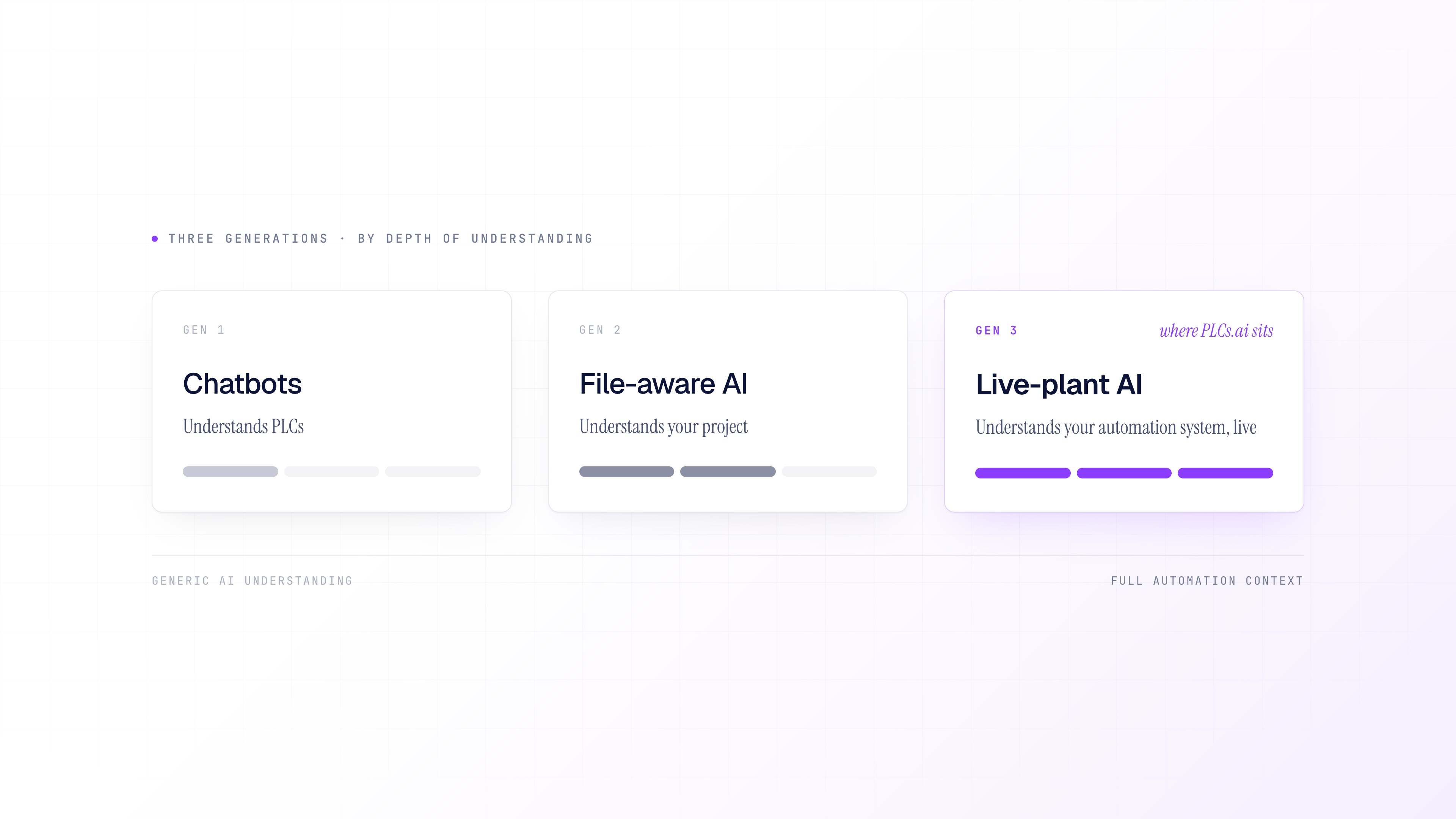
The three generations of AI for PLC work: chatbots, file-aware AI, and live-plant AI.
AI for PLC work splits into three generations: chatbots that understand PLC concepts, file-aware AI that understands your project, and live-plant AI that understands what the automation system is doing right now. Knowing which one you are looking at changes what you can ask it.
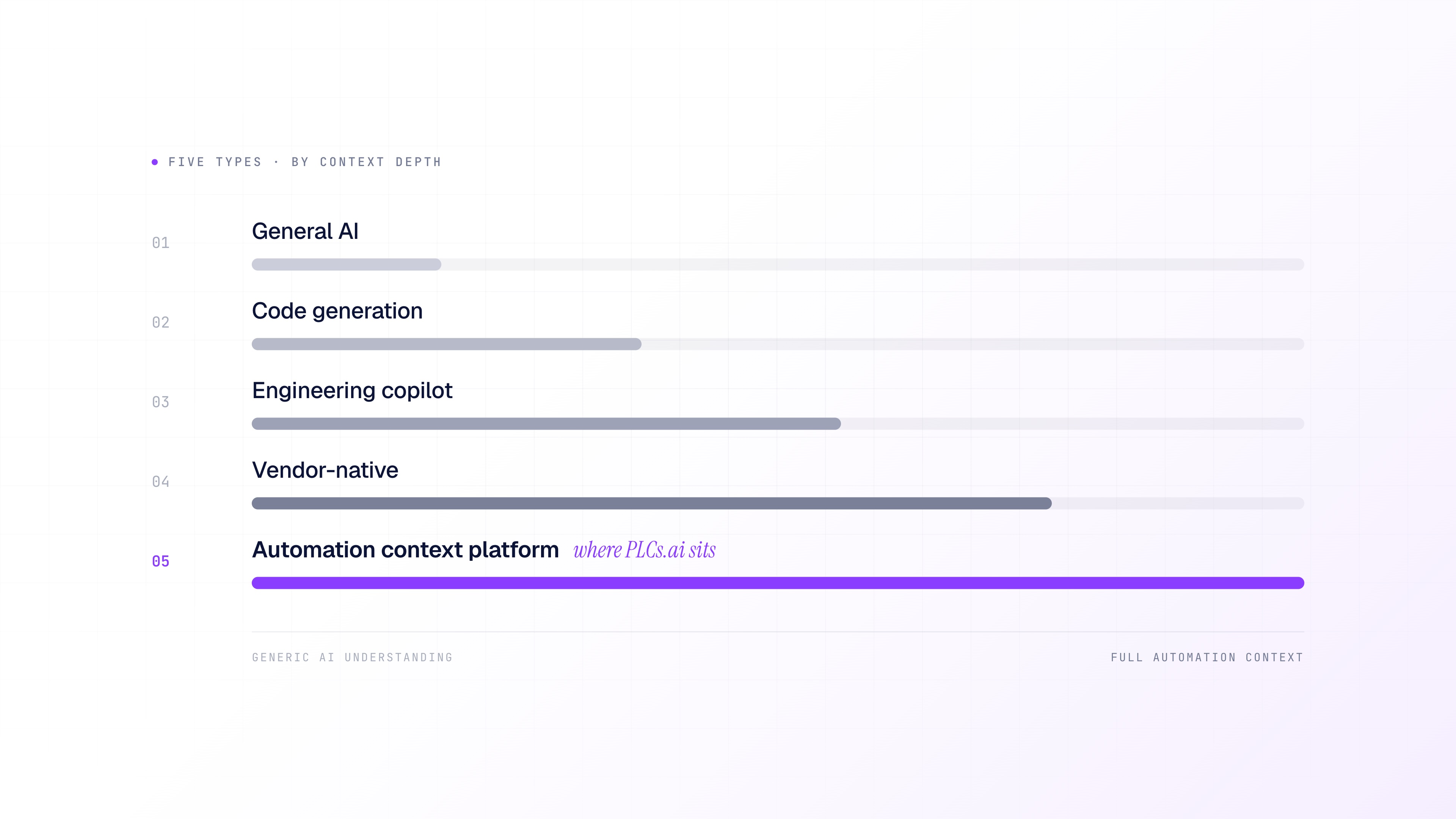
What is PLC AI? A guide to AI for PLC programming and industrial automation.
PLC AI is not one product category. It is five, and picking the wrong one costs you time before you even start. What the term means, what AI can already do with a PLC, the five types of tools on the market, and where PLCs.ai sits among them.