
Can AI read ladder logic? Here is what actually works.
Yes, modern AI can read ladder logic. The real question is whether it can read yours: the whole project, the tag aliases, the UDTs, the line around it. That is where most tools stop and where the useful work begins.
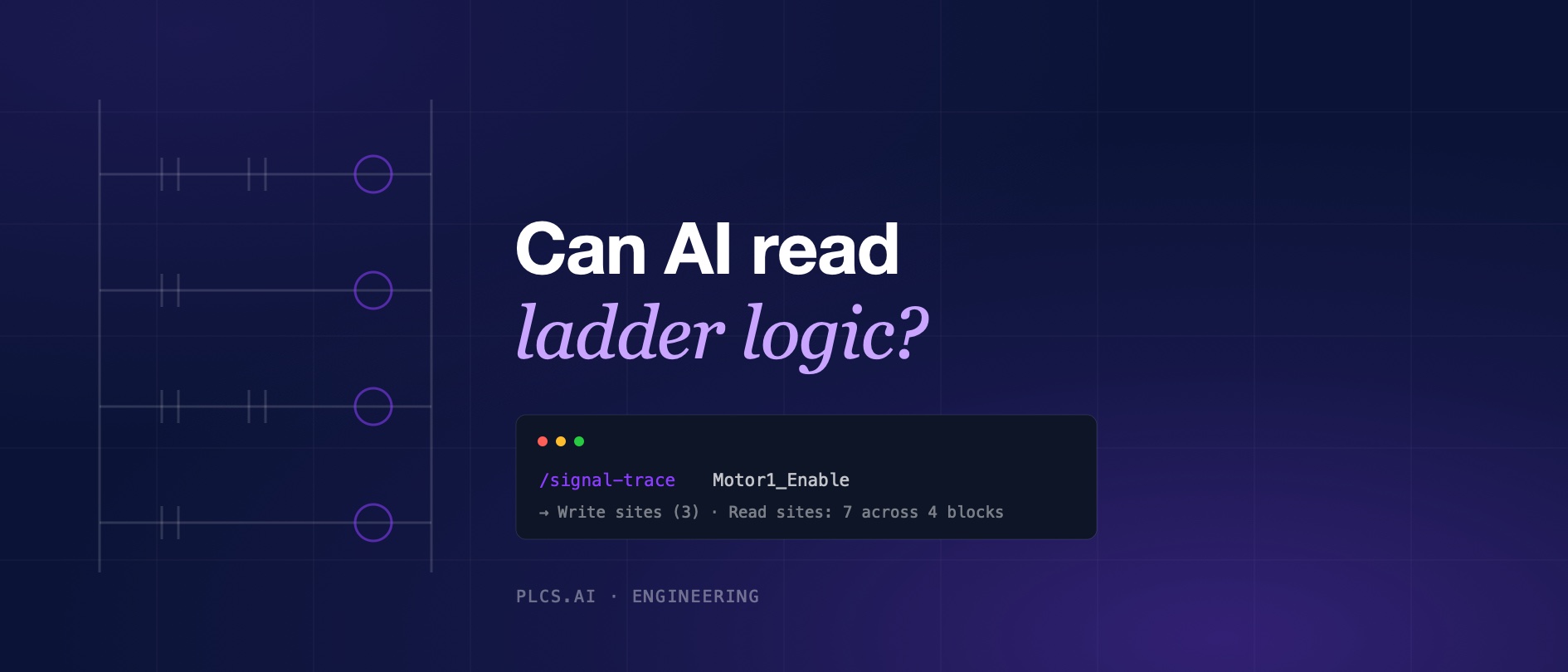
Yes, modern AI can read ladder logic. It can look at a rung and tell you, in plain English, what the instructions do. That part is solved. The real question is whether it can read your ladder logic: fifteen years of undocumented changes, tag names only one retired engineer understood, and logic spread across routines, UDTs, and AOIs that all reference each other. That is where most tools stop, and where the useful work begins.
What AI can already do with ladder logic
Applied to a full project rather than a pasted fragment, AI is already doing real work on production code today:
- 01Explain any rung, routine, or whole program in plain English, including what it does, why it is there, and what depends on it.
- 02Trace a signal through every read and write site across the project, the job our /signal-trace skill does in seconds.
- 03Find dead code: rungs whose conditions can never be true, blocks nobody calls, flags written but never read.
- 04Catch race conditions and scan-order bugs, where two tasks write the same tag and whichever runs last wins.
- 05Audit interlock chains for missing reset confirmations and bypasses with no timeout guard.
- 06Generate new logic from a plain-language prompt, with a simulate-and-review step before anything touches the controller.
Where general-purpose chatbots fall short
Paste a rung into a general-purpose chatbot and you will get a competent explanation of that rung. But a pasted fragment has no cross-references. The chatbot cannot see the UDT behind the alias, the routine that writes the tag it reads, or the three stations downstream that depend on its output. It has no concept of a production line made of multiple connected PLCs, no simulate-and-review step, and no memory of your standards from one session to the next.
The question is not whether AI can read a rung. It is whether it can read your plant.
What it takes to read a whole project, not a fragment
Reading real ladder logic means parsing the native project structure, not screenshots or pasted text. For Allen-Bradley, that is the full Studio 5000 L5X export: every routine, tag, UDT, and AOI, with cross-references intact. For Siemens, our Desktop Companion App uses the TIA Portal Openness API to export the project directly, no manual step.
It also means reading beyond one controller. With 3D Line Context, PLCs.ai reasons across every PLC on a production line, even mixed Allen-Bradley and Siemens lines, as a single surface. And with live tag values streaming from the running controller, troubleshooting is grounded in what the line is doing right now, not just what the code says it should do.
Why this matters for downtime
Siemens’ True Cost of Downtime report (2024) puts the average plant at 25 unplanned stops and 27 downtime hours per month, with a 65-minute mean time to repair. Reliability engineering handbooks have shown for decades that hands-on repair is only 30 to 40 percent of that time. The rest is finding the fault: working out why the line stopped before anyone can fix it.
That fault-finding share is exactly what reading ladder logic faster attacks. When any engineer on shift can ask the code why the conveyor will not start, and get an answer that traces the permissives and interlocks back to the exact rung, the longest part of the outage gets shorter.
Put your own numbers on it with the downtime calculator →How to try it on your own code
The honest way to answer “can AI read ladder logic” is to hand it yours. Upload a Studio 5000 or TIA Portal project, ask it the question your team asked during the last outage, and judge the answer against what your best engineer would say.
See the full comparison with general-purpose chatbots →More from the blog
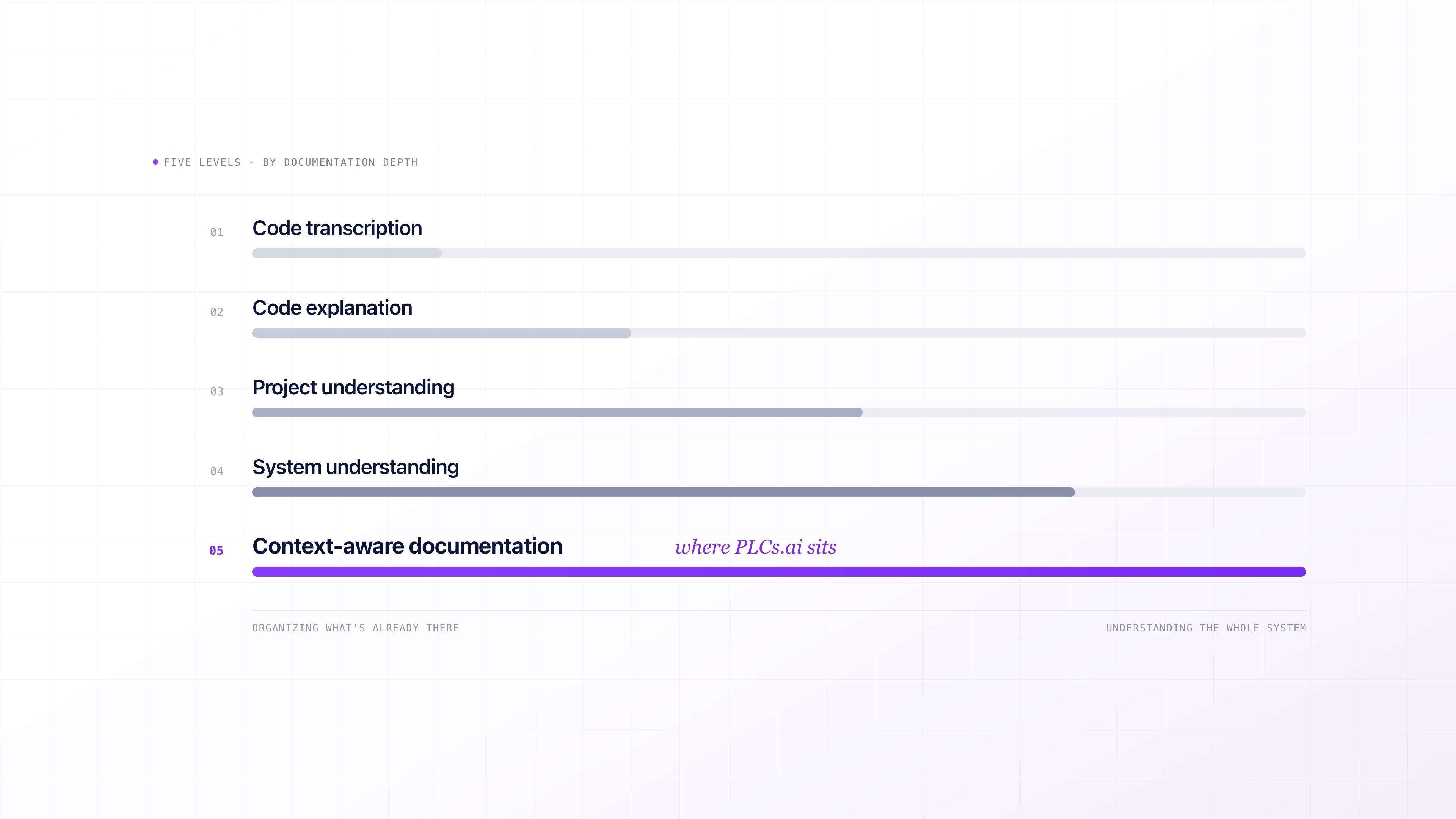
PLC documentation software: 9 tools compared (2026).
Automatic PLC documentation ranges from deterministic tools that reformat what is already in the project, to AI that infers meaning from undocumented code, to platforms that generate documentation from a broader understanding of the automation system. Nine real tools, compared on what they actually do.
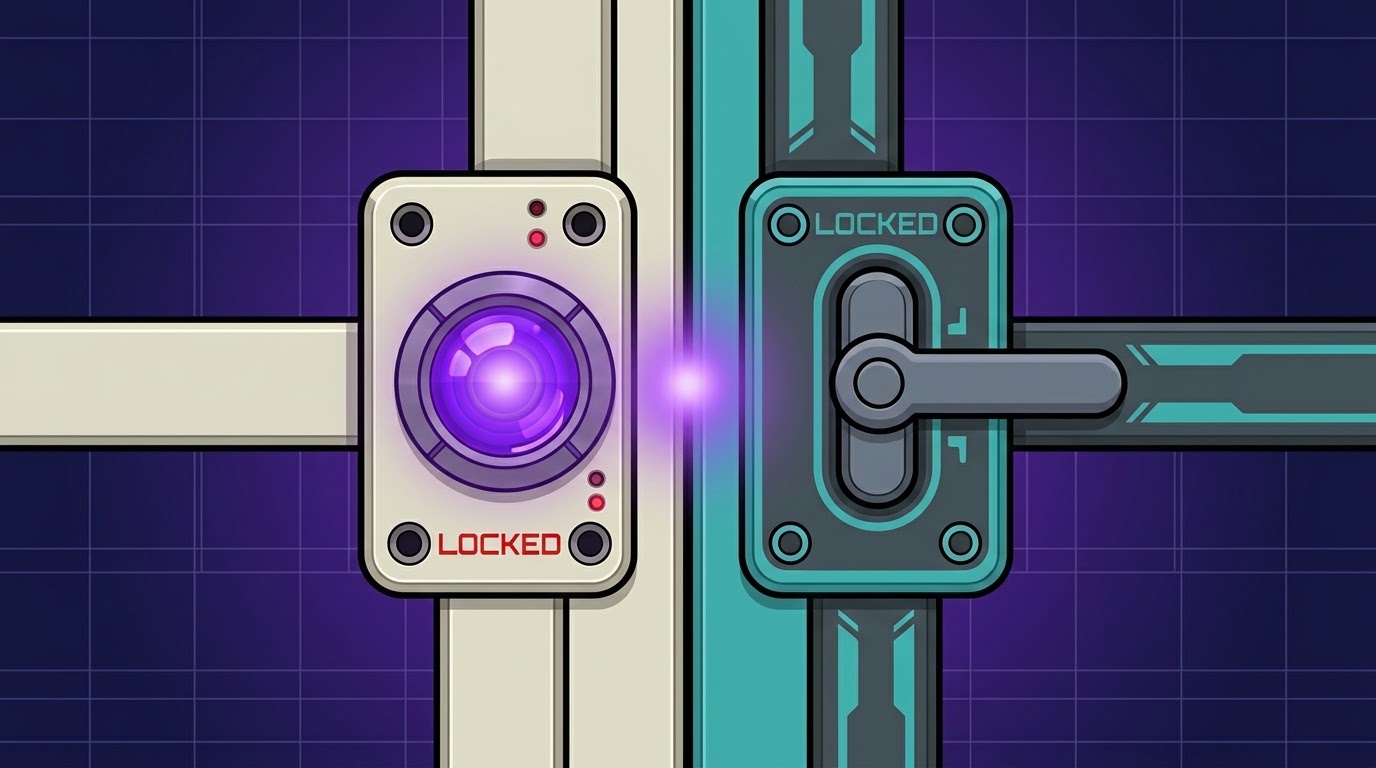
Why industrial AI must understand the entire production line, not just one PLC.
Production lines are rarely single-vendor. A stopped machine on an Allen-Bradley PLC can be waiting on a permissive that only makes sense once you look at the Siemens PLC next to it. What mixed-vendor line context means, why it is different from simply supporting multiple PLC vendors, and how AI can trace a fault across both sides of that handshake.
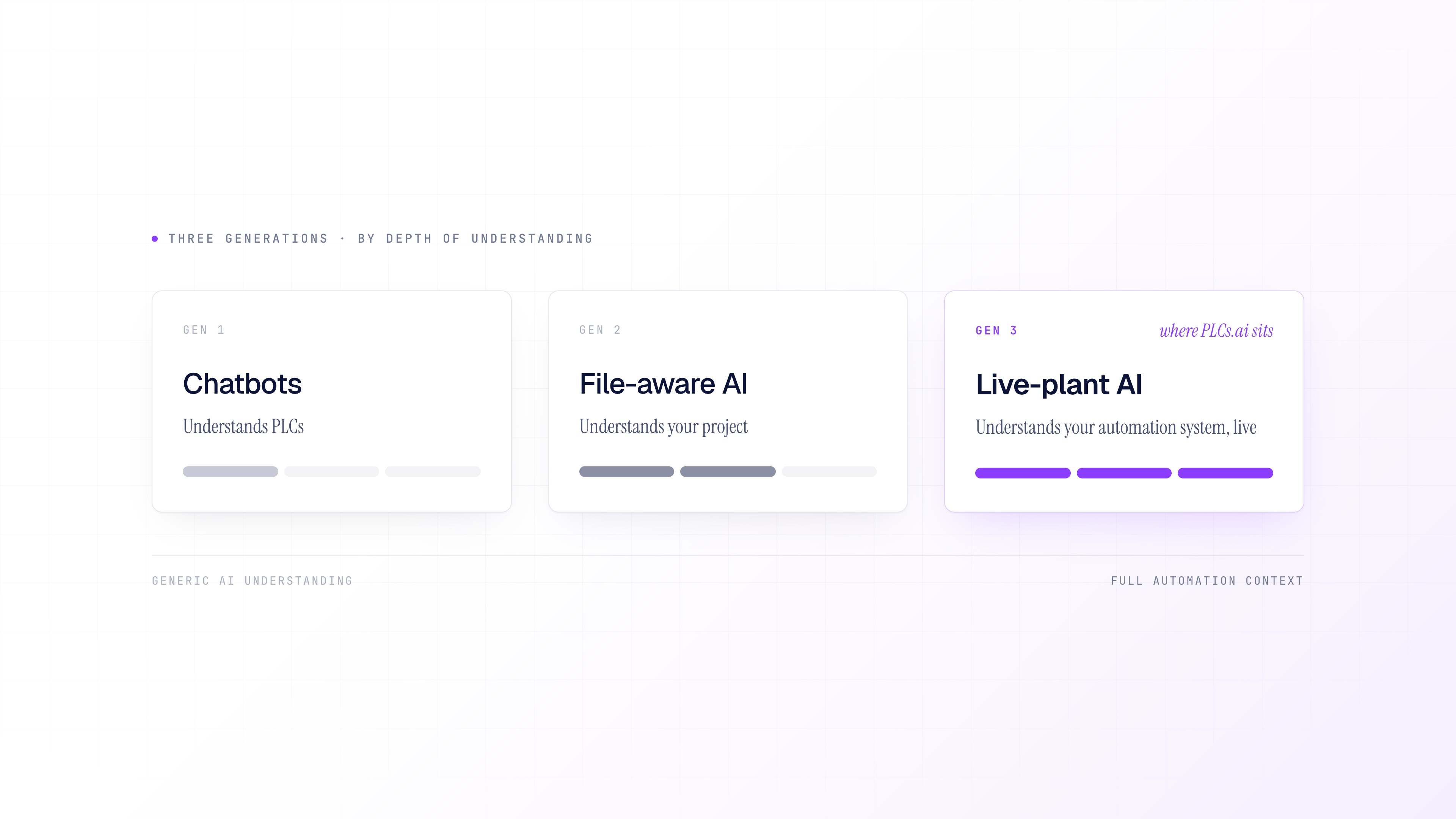
The three generations of AI for PLC work: chatbots, file-aware AI, and live-plant AI.
AI for PLC work splits into three generations: chatbots that understand PLC concepts, file-aware AI that understands your project, and live-plant AI that understands what the automation system is doing right now. Knowing which one you are looking at changes what you can ask it.